8th International Conference on Applied Category Theory
About
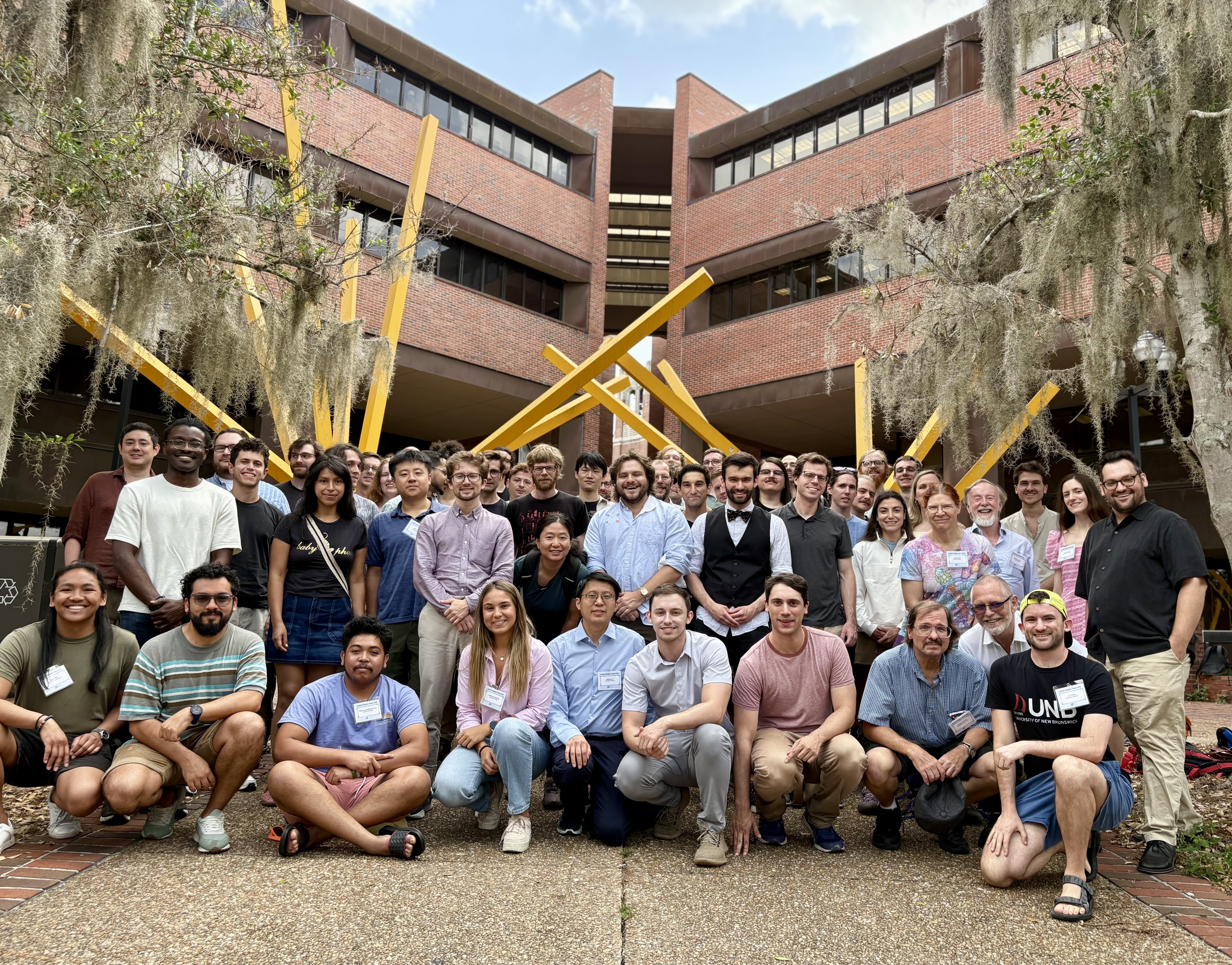
The 8th International Conference on Applied Category Theory (ACT) took place together at the University of Florida on June 2-6, 2025. The conferences were preceded by the Adjoint School on May 26-30, 2025.
For more information on the ACT series, see here.
This conference has taken place
ACT 2025 was held at the University of Florida on June 2-6, 2025. This page is kept as a record of the event; the call for participation and the schedule are preserved below. Registration is closed.
Important dates
All deadlines were AoE (Anywhere on Earth).
- February 26: Title and brief abstract submission
- March 3: Paper submission
- April 7: Notification of authors
- May 19: Registration deadline and Pre-proceedings ready versions
- June 2-6: Conference
Venue
The conference was held at the UF Reitz Union in the Career Connection Center
J. Wayne, Reitz Student Union, 686 Museum Rd Suite 1300, Gainesville, FL 32603
Parking is available in the Reitz Union Garage at approximately $8 per day. Payments are made through the Passport parking app by credit card or mobile payments.
The conference took place in the Connections room of the Career Connections Center on Level 1 of the Reitz Union. Technology available included a desktop computer, projector screen, and a confidence monitor for the presenter.
Conference info
Lunch and coffee were provided for attendees. This understandably meant that there were registration fees. We used a tiered system based on occupation category:
- Students $140
- Academics $300
- Industry professionals $700
Travel and registration assistance was available to students depending on final registration numbers and funds available. Applications were made through this form.
Due to technological constraints, only the keynote addresses and the community meeting were accessible via Zoom. Recordings of presentations were made available after the conference on a best-effort basis. For exceptional circumstances in which a presenter could not attend in person, submissions could be published in conference proceedings alone, and/or a recorded presentation made available after the conference.
Adjoint School
More information about the adjoint school can be found at adjointschool.com.
LGBTQ+ statement
The 2025 conference for Applied Category Theory was held at the University of Florida in Gainesville, Florida. As organizers, we understand that the current political climate and legal policies of the state of Florida do not instill a sense of comfort and safety in individuals from marginalized communities, especially the LGBTQ+ community. However, the organizers, University, and local community are committed to creating a welcoming environment for all. Along with the ACT community, Gainesville, FL is a kind and welcoming place for individuals of all backgrounds and experiences. Organizers and attendees of ACT 2025 will not tolerate any abuse or discrimination, direct or indirect, against members of the LGBTQ+ community. This event was an opportunity to learn from each other, build connections and collaborations, and discuss our research and pedagogy in applied category theory. We welcome all members of the ACT community to participate in this endeavor, regardless of gender, sexuality, race, religion, etc.
Inclusive spaces resources
Please refer to the UF Libraries page for finding inclusive spaces on campus. Here is a map of inclusive spaces on campus.
Organizers can confirm that most buildings on campus, including the one the conference activities took place in, have multiple accessible, single-occupancy restrooms. The available campus map also shows all locations of single-occupant restrooms, ADA accessible routes between buildings, bus stops, and more via the filter options in the top left corner of the map.
Organizers
- Program Chairs
- Local Chair
Schedule
Accepted presentations
| Category | Author(s) | Title |
|---|---|---|
| Talk | David Norris | A Categorical Formulation of Dose-Escalation Trial Protocols Extending Naturally to Admit Titration |
| Talk | Joe Moeller, Aaron Ames and Paulo Tabuada | A categorical framework for Lyapunov theory |
| Proceedings | Joe Pratt-Johns, Toby St Clere Smithe, Chris Guiver, Kevin Hughes and Peter Andras | A Category Theoretic View of Algebraic Artificial Chemistries |
| Proceedings | Anna Matsui, Innocent Obi, Guillaume Sabbagh, Leo Torres, Diana Kessler, Juan F. Meleiro and Koko Muroya | A Critical Pair Enumeration Algorithm for String Diagram Rewriting |
| Talk | Jorge Soto-Andrade and Juan-Carlos Letelier | A stochastic mapping approach to the construction of objects according to the biology of cognition |
| Talk | Victor Bloch and Tobias Fritz | A universal perspective on probability monads |
| Talk | Jacob Zelko, Matt Cuffaro and Sean Wu | ACT-Informed Data Science: A Case Study in Public Health Research |
| Software Demo | James Fairbanks and Evan Patterson | AlgebraicJulia: Compositional Development of Compositional Mathematics Software |
| Talk | Ruben Van Belle | Algebras of the Giry monad |
| Software Demo | Kevin Carlson, Owen Lynch, Kris Brown and Evan Patterson | CatColab: formal, interoperable, conceptual modeling |
| Proceedings | Jiaheng Lu | Categorical Calculus and Algebra for Multi-Model Data |
| Proceedings | Robin Cockett and Melika Norouzbeygi | Categorical Semantics of Higher-Order Message Passing |
| Talk | Owen Lynch, Eigil Rischel, David Jaz Myers and Sam Staton | Clock systems for stochastic and non-deterministic categorical systems theories |
| Proceedings | Marius Furter, Yujun Huang and Gioele Zardini | Composable Uncertainty in Symmetric Monoidal Categories for Design Problems |
| Talk | Tyler Hanks, Matthew Klawonn, Matthew Hale and James Fairbanks | Compositional Semantics of Convex Optimization |
| Talk | Jonas Forster, Lutz Schröder and Paul Wild | Conformance Games for Graded Semantics |
| Proceedings | Eigil Rischel | Convex duality made difficult |
| Proceedings | Keri D'Angelo and Sophie Libkind | Dependent Directed Wiring Diagrams for Composing Instantaneous Systems |
| Talk | Rob Cornish | Eilenberg-Moore categories of Markov monads |
| Talk | Paolo Perrone, Tobias Fritz, Tomáš Gonda, Antonio Lorenzin and Areeb Shah Mohammed | Empirical Distributions and Strong Laws of Large Numbers in Categorical Probability |
| Talk | Juan Afanador | Gradual Semantics of Abstract Argumentation, categorically through Prisms |
| Software Demo | Paul Wilson | HyperSyn: macro morphism metaprogramming (software demonstration) |
| Talk | Gabriel Goren-Roig | Idempotent Arboreal Covers |
| Talk | Sébastien Mattenet, Joe Moeller and Aaron Ames | Lyapunov's theorem for coalgebras |
| Talk | Paolo Perrone | Markov categories with random variables |
| Talk | Areeb Shah Mohammed | Partializations of Markov categories |
| Talk | Tiffany Duneau, Saskia Bruhn, Gabriel Matos, Tuomas Laakkonen, Katerina Saiti, Anna Pearson, Konstantinos Meichanetzidis and Bob Coecke | Scalable and interpretable quantum natural language processing: an implementation on trapped ions |
| Talk | Cihan Okay, Victor Castillo and Walker Stern | Simplicial effects as generalization of effect algebroids |
| Talk | Aziz Kharoof and Cihan Okay | Simplicial methods in the resource theory of contextuality |
| Talk | John Morris, Gregory Mocko and John Wagner | System Modeling and Simulation via Constraint Hypergraphs |
| Software Demo | Christian Wells | Visual Logic Interface (software demonstration) |
| Talk | Fabian Wiesner, Ziad Chaoui, Diana Kessler, Anna Pappa and Martti Karvonen | Why quantum state verification cannot be both efficient and secure: a categorical approach |
Outing options
Kayaking
Dorrette Pronk pronk@mathstat.dal.ca is leading a kayaking trip in Silver Springs, FL departing the conference venue at 7:30 AM Wednesday. Please email by Monday 6/2/2025 by 6pm to join. Include in the email if you have a vehicle and can drive people to attend.
Sweetwater Wetlands Park
Sweetwater Wetlands is a great place to explore the flora and fauna of north central Florida. Alligators abound along with many different species of native and migratory birds. Bring sun protection and water!
The park entrance fee is just the parking of approximately $5.
UF Art Museum
For those looking for an indoor activity, the Harn Museum of Art is on campus and an entertaining option.