The GATAS Lab

Graduations!

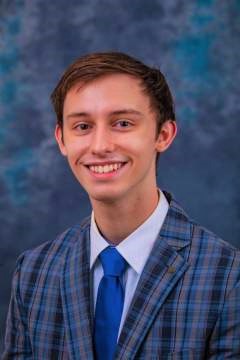
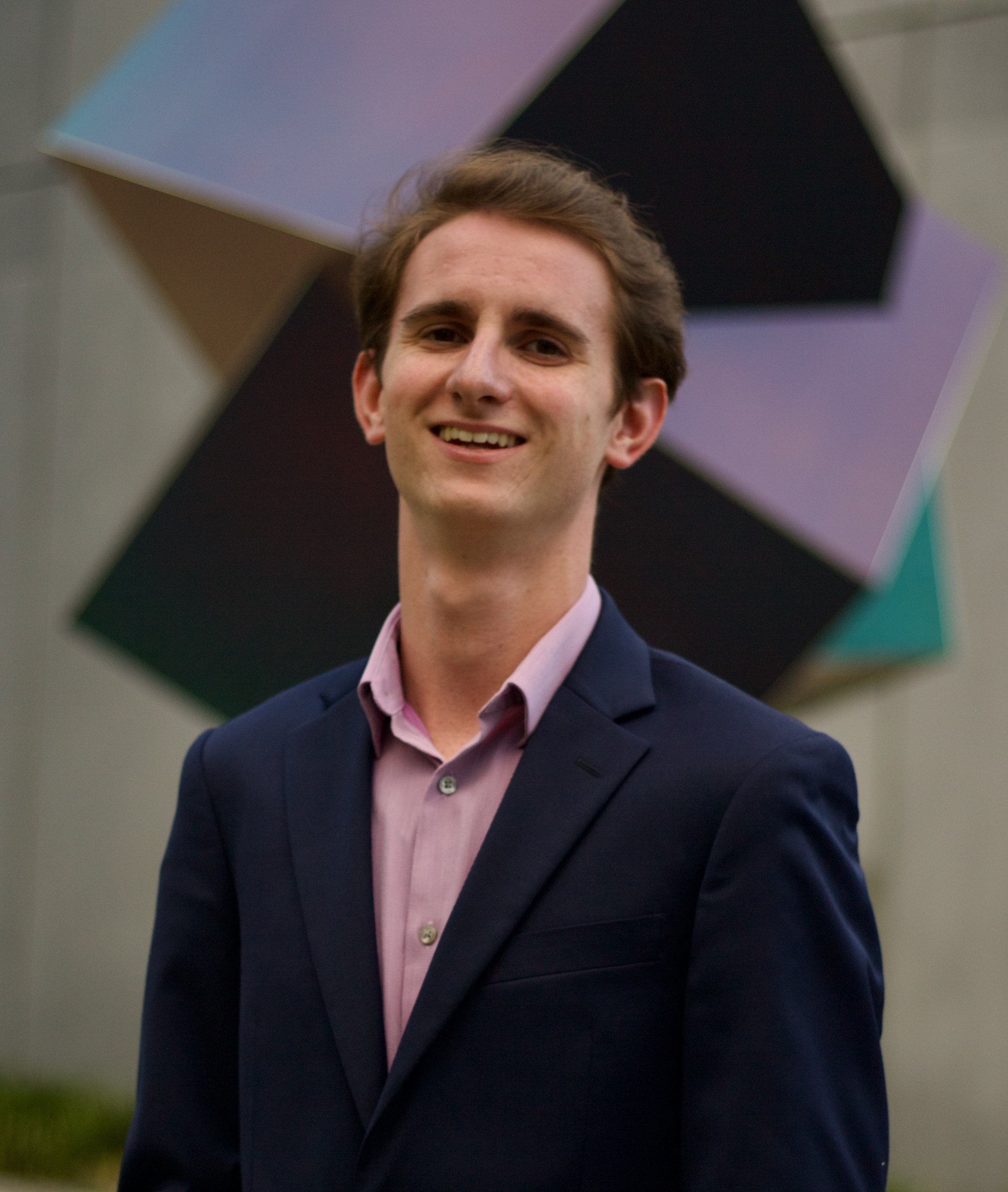
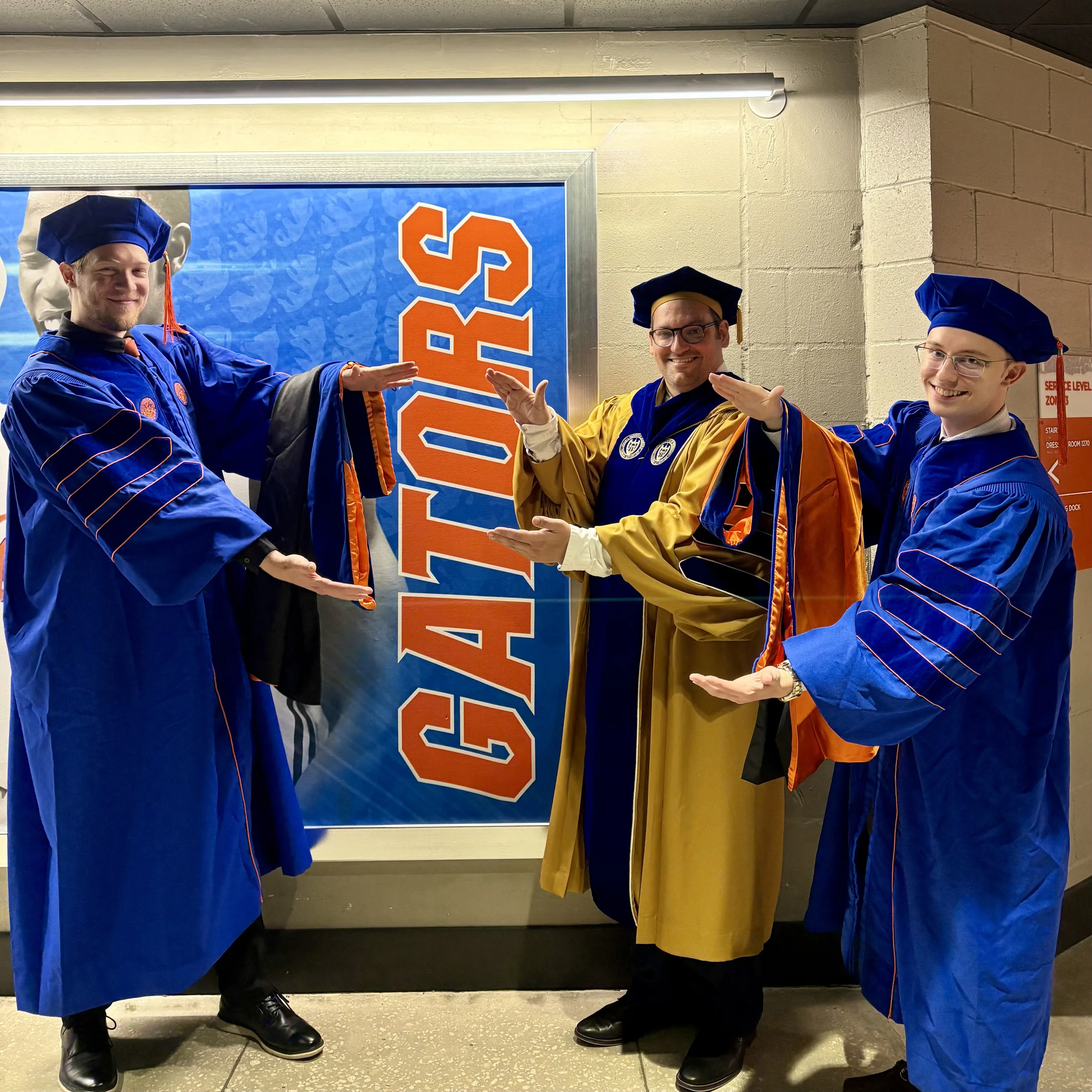
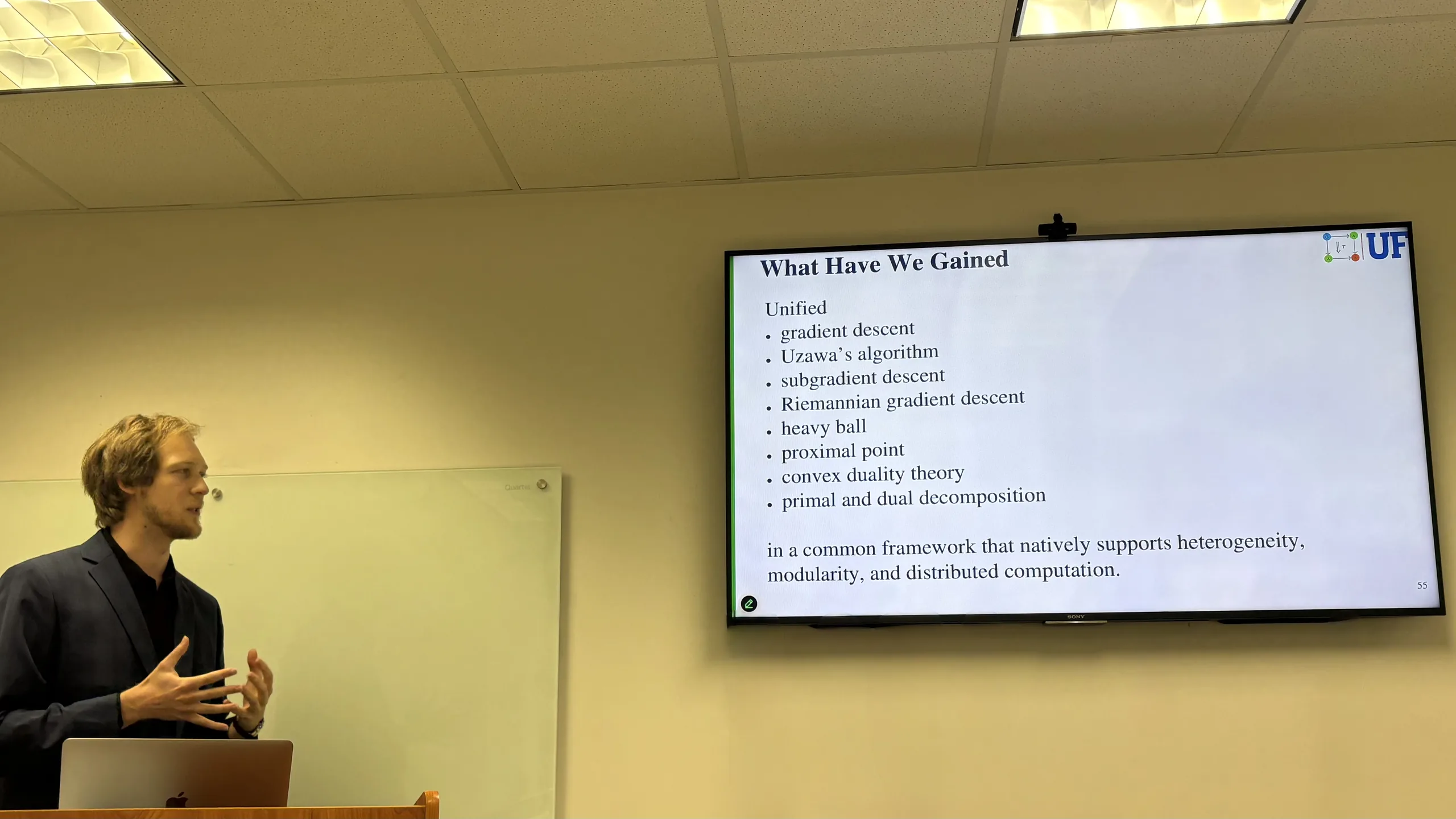
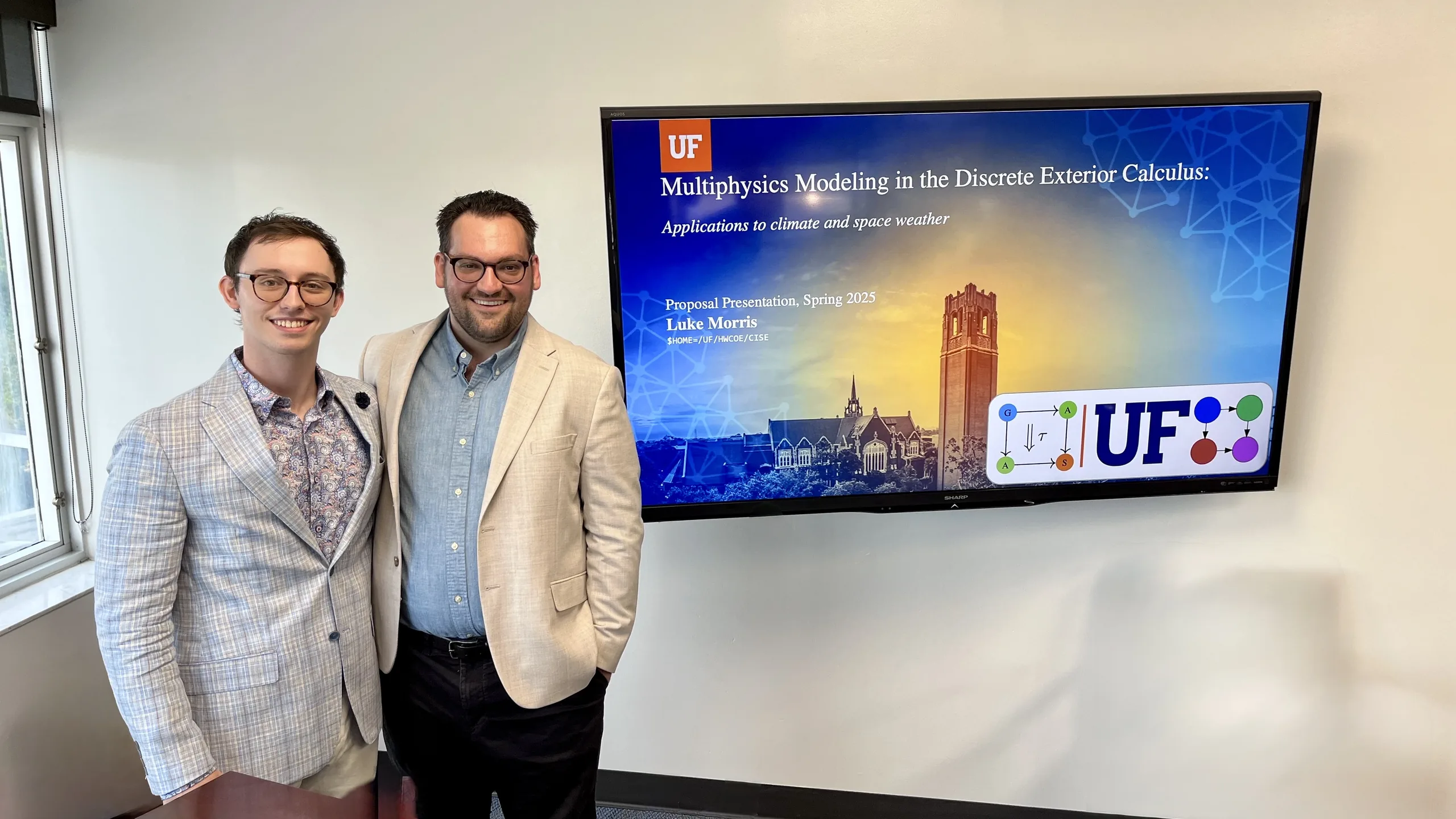
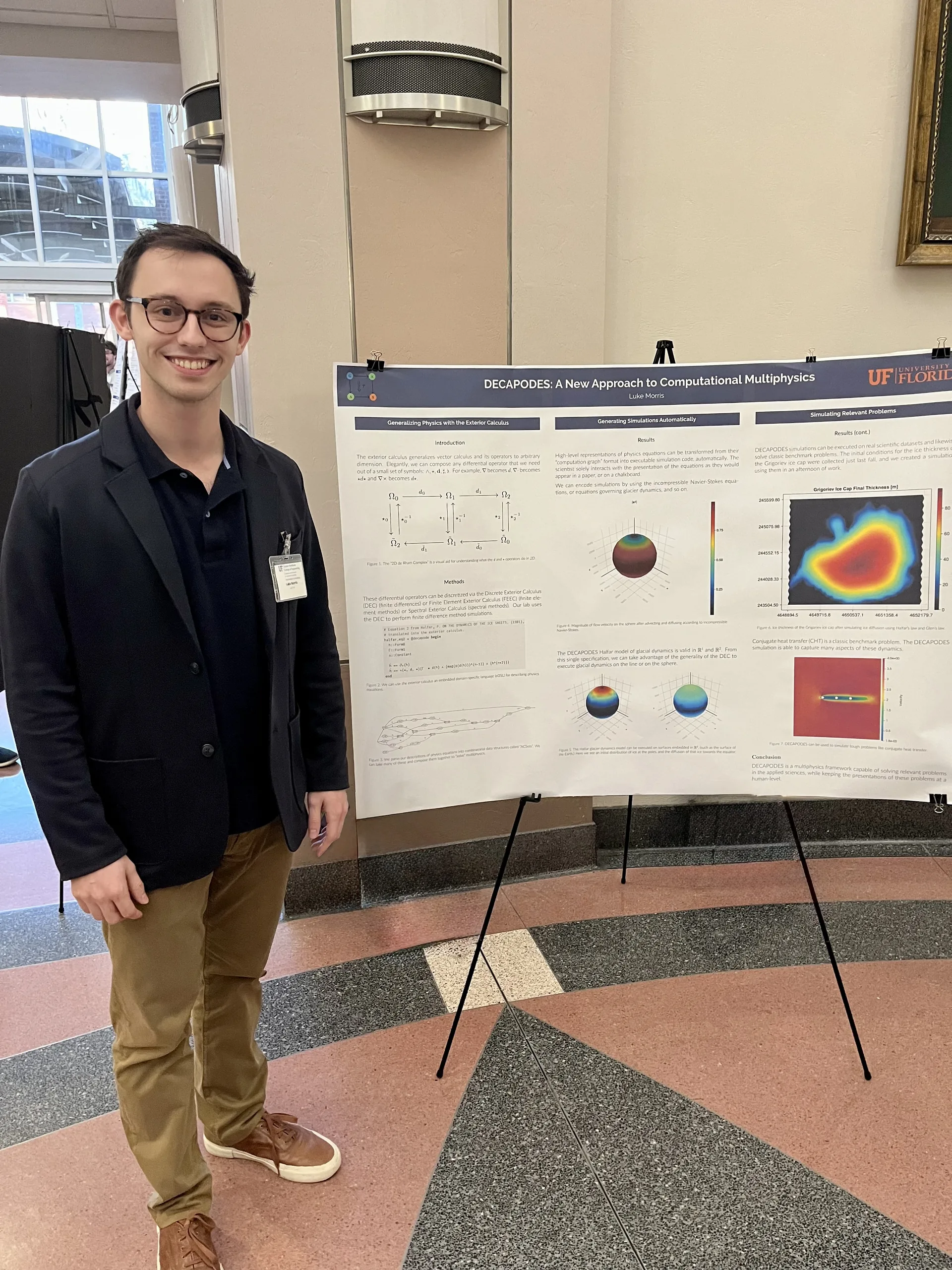
The GATAS Lab graduated two PhD students this year! Tyler Hanks and Luke Morris are our first two PhD Graduates.

Applied Category Theory 2025

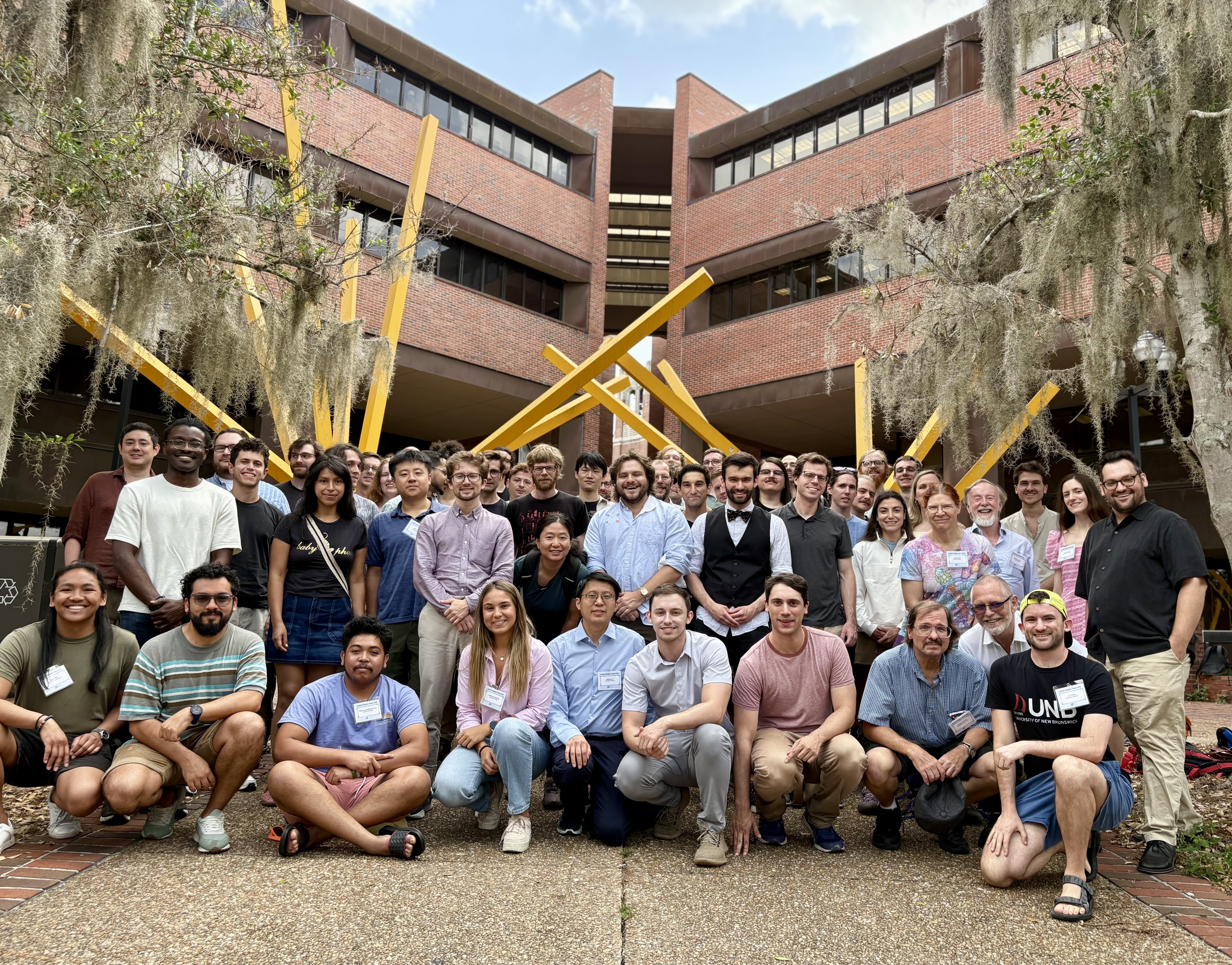
The GATAS Lab hosted the 8th International Conference on Applied Category Theory here at UF. For more information see the ACT 2025 page.

GATAS Lab at the University of Florida GATAS Lab at the University of Florida

The GATAS (Generalized Algebraic Techniques Advancing Science) laboratory uses applied category theory to develop novel approaches to scientific computing. We are domain-agnostic, solving problems in dynamics, physics, biology, the life sciences, and industrial engineering. Our group works closely with Evan Patterson’s research group at the Topos Institute to maintain and develop the AlgebraicJulia software ecosystem.

Philosophy

Scientists develop simulations by translating scientific concepts into mathematical models, and then embodying those models in software. We seek to automate this process using category theory. Category theory is a mathematical language rich enough in abstraction to represent any scientific concept, yet pliable enough to manipulate efficiently with a computer. The software in AlgebraicJulia encodes a number of these abstractions; with it, scientists can build powerful, robust, and bespoke scientific models without starting from scratch in each domain.

Explore the lab

Projects

Our current research projects, each composed of multiple publications.

Members

The people of the GATAS Lab — current members, alumni, and mentees.

Publications

The lab’s complete bibliography — journal articles, proceedings, talks, posters, and preprints.

Sponsors

The federal agencies whose grants and contracts support the lab.

Subsections of The GATAS Lab

Members

The members of the lab come from diverse perspectives with unique training. We are always looking for students and researchers with a desire to solve problems by leveraging abstract applications in novel science and engineering applications.

Accepting applications for

  • PhD Students in both MAE and CISE. Mathematically minded students would benefit from the MAE degree program specializing in Dynamics, Systems, and Control.
    • For MAE applicants, the GATAS lab is particularly well suited to students interested in either Dynamics, Systems, and Control for optimization and dynamics projects or Computational Fluid Dynamics (CFD) for the Decapodes project.
    • For CISE students, the GATAS lab is a good fit for students interested in High Performance Computing (HPC), Machine Learning, Data Science, Applied and Computational Mathematics, Computer Algebra, and Programming Language Theory.
  • Research Projects for Undergraduates and Graduate Students in MAE, CISE, and Math
  • Research Scientists and Postdocs in MAE, CISE, and Math

Email fairbanksj [at] ufl [dot] edu for all new position inquiries

If you are interested in a career in Applied Category Theory or Computational Science and Engineering, please reach out.

Current members

James Fairbanks

Principal InvestigatorComputational Science and EngineeringPhDAsst. Prof.Lab member since 2021

Principal investigator; assistant professor in Mechanical and Aerospace Engineering.

George Rauta

CISEPhDStartingLab member since 2022

PhD student focused on numerical linear algebra and high-performance computing.

Richard Samuelson

PhDDoctoral studentLab member since 2024

Doctoral student researching category theory, convex analysis, and high-performance computing.

Joana Bou Barcelo

MAEPhDLab member since 2024

PhD student in Mechanical and Aerospace Engineering applying cellular sheaves to multi-agent control.

Itay Kadosh

MAEPhDLab member since 2026

PhD student working on robotics, computer vision, and optimization.

Samuel Cohen

Undergraduate researcherLab member since 2024

Undergraduate studying math and computer science; works on AlgebraicOptimization.jl.

Alumni

Tyler Hanks

CISEPhDGraduatedLab member since 2021

First GATAS PhD graduate; optimization, control theory, and machine learning.

Luke Morris

CISEPhDGraduatedLab member since 2021

Leads development of CombinatorialSpaces.jl and Decapodes.jl.

Trevor Gross

Undergraduate researcherLab member since 2025

Undergraduate in computer science working on AlgebraicOptimization.jl.

Wilmer Leal

Postdoctoral FellowPhDWritingLab member since 2022

Postdoctoral researcher working on categorical models of compositionality in chemistry.

Matt Cuffaro

Research Software EngineerCrushing itLab member since 2023

Systems administrator and research programmer for the GATAS Lab.

Benjamin Merlin Bumpus

Research Assistant ProfessorPhDWritingLab member since 2022

Led the algorithms subproject; now heads the CUÍCA lab at the University of São Paulo.

Past members

NameWhere are they now?
Chris RuglesteinUF Mathematics
James HornMaster’s Student at Georgia Tech
Kris BrownResearch Software Engineer at the Topos Institute
Micah HalterResearch Scientist at the Georgia Tech Research Institute
Caroline RogersIndustry
Rebecca BoesIndustry
James EschrichPhD Student at University of Illinois (UIUC)
Taylor FrederickIndustry
Patrick StokesGatorSense Lab at UF ECE

Lab mentees

These are people who might not have spent full-time employment in the lab, but were involved in a mentorship program or ongoing mentoring relationship outside beyond the institution.

NameProgramLast Known InstitutionDates
Kris BrownUF Post-Doctoral ResearcherTopos Institute, Research Software Engineer2021-22
Anna KnoerrACT Adjoint SchoolETH Zurich2021
Grant GenerauxACT Adjoint SchoolBristol Myers Squibb2021
Amy SearleACT Adjoint SchoolOxford Physics, PhD (graduated 2024)2021
Kris BrownACT Adjoint SchoolUF, Post-Doctoral Researcher2021-2022
Sophie LibkindMathematics, Stanford UniversityTopos Institute, Mathematician2020-2022
Owen LynchStatistics, University of UtrechtTopos Institute, Research Software Engineer, PhD Student Oxford University2020-Present
Julian PerezBS BME GTStanford, PhD Student2021-22
Stephen WellburgBS DAS UFCapital One, Software Engineer2021-22
Sreenath RepartiBS ISYE Georgia TechKPMG2018-19
Kun CaoMS CS Georgia TechGT2019
Micah HalterBS CS Georgia TechGTRI2016-19
Nate KnaufBS CS Georgia TechGT2016
Rohit VarkeyMS CS Georgia TechGoogle2016-18
Pushkar GodboleMS CSE Georgia TechYelp2015

Subsections of Members

James Fairbanks

James Fairbanks
Role
Principal Investigator
Program
Computational Science and Engineering
Degree
PhD
Status
Asst. Prof.
Lab member since
2021

James Fairbanks is an assistant professor in the department of Mechanical and Aerospace Engineering, and affiliated with the Institute for Computational Engineering, and the Florida Institute for National Security.

My research focuses on new paradigms in scientific computing, specifically applied category theory. This approach to mathematical modeling focuses on structure and structure preserving relationships between mathematical objects. The GATAS lab studies these topics and supports software-focused research in the AlgebraicJulia Ecosystem. We collaborate closely across the HWCOE and with external collaborators at NIST, AFRL, and the Topos Institute.

George Rauta

George Rauta
Program
CISE
Degree
PhD
Status
Starting
Lab member since
2022

George Rauta is a PhD student with a focus in numerical linear algebra and high-performance computing.

I believe that advances in the field of computer science are dependent on the existence of a highly performant computational foundation. It is critical that this foundation considers the theoretical aspects of algorithms, the method by which they are implemented in code and how they interact with the physical designs of modern processing and memory units.

I am also a developer on the Decapodes.jl and CombinatorialSpaces.jl projects.

Richard Samuelson

Richard Samuelson
Degree
PhD
Status
Doctoral student
Lab member since
2024

Richard Samuelson is a doctoral student researching category theory, convex analysis, and high-performance computing. He has made significant contributions to the CliqueTrees.jl package, implementing the ChordalLDLt multifrontal factorisation that underpins sparse symmetric positive-definite linear solves. These improvements accelerate nullspace and global-section computations in the CellularSheaves.jl library and enable more efficient compositional methods across the lab’s projects.

Selected publications

  • Graphical Quadratic Algebra – ICTAC 2025 (Lecture Notes in Computer Science). Dario Stein, Fabio Zanasi, Robin Piedeleu, and Richard Samuelson. DOI: 10.1007/978-3-032-11176-0_18
  • A Categorical Treatment of Open Linear SystemsLogical Methods in Computer Science, 2025. Dario Stein and Richard Samuelson. DOI: 10.46298/lmcs-21(3:11)2025

Joana Bou Barcelo

Joana Bou Barcelo
Program
MAE
Degree
PhD
Lab member since
2024

Joana Bou Barcelo is a PhD student in the Department of Mechanical and Aerospace Engineering at the University of Florida, working at the boundary between the GATAS Lab’s compositional methods and nonlinear control.

Her work applies cellular sheaves to coordination problems in multi-agent systems. In Heterogeneous Multi-Agent Multi-Target Tracking using Cellular Sheaves, written with Tyler Hanks, Cristian F. Nino, Austin Copeland, Warren Dixon, and James Fairbanks, the team poses the tracking of several unknown targets as a harmonic extension problem on a cellular sheaf. Because a sheaf can carry a different stalk over each agent, the formulation handles agents whose state spaces have different dimensions — the heterogeneity that makes these problems awkward to write down in the usual graph-Laplacian setting. The resulting decentralized controller is built from the sheaf Laplacian and comes with Lyapunov-based stability guarantees.

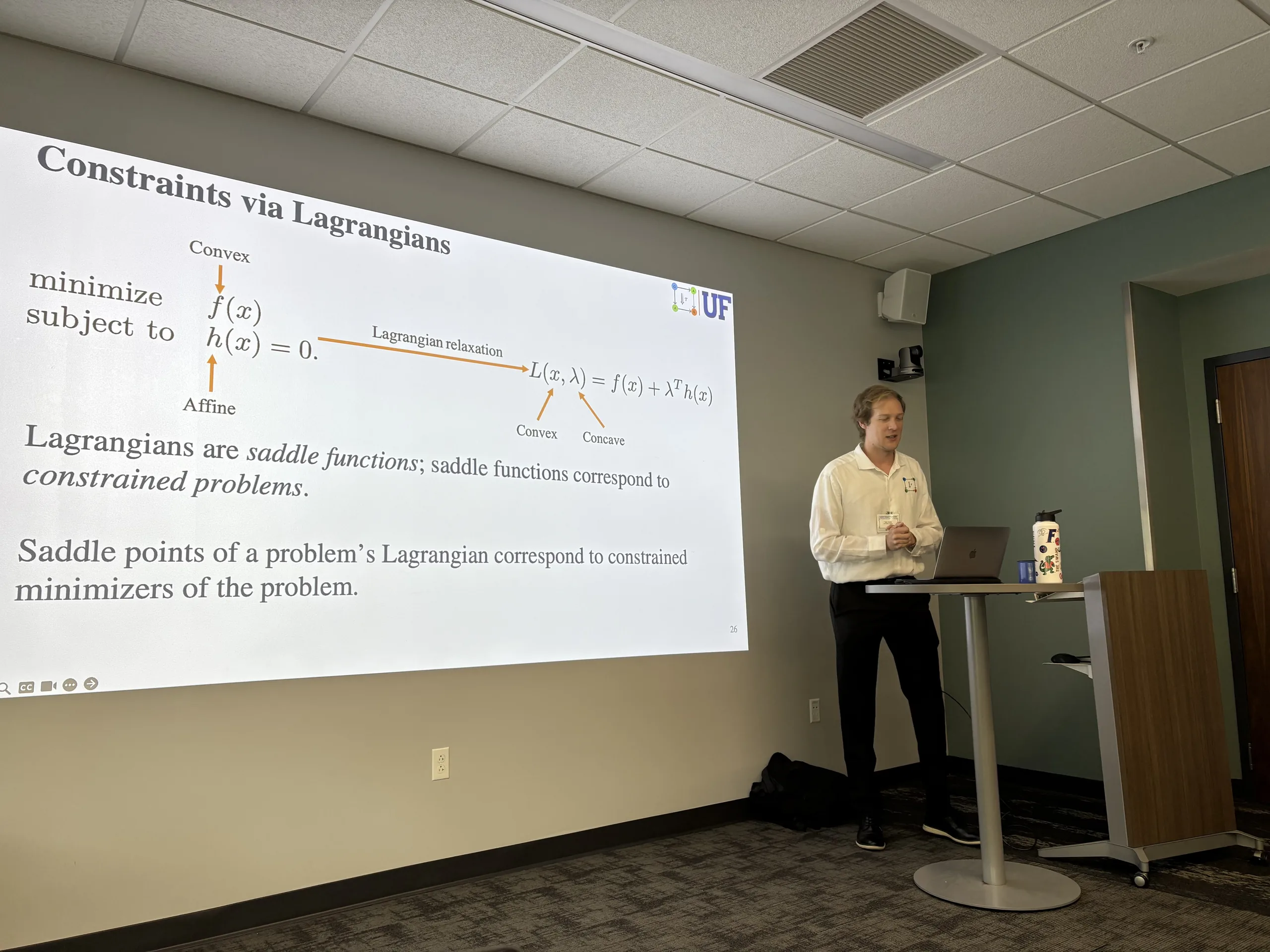
She presented this work as Heterogeneous Multi-Agent Multi-Target Tracking at the INFORMS Optimization Society Conference in Atlanta in March 2026.

Selected publications

  • Heterogeneous Multi-Agent Multi-Target Tracking using Cellular Sheaves. Tyler Hanks, Cristian F. Nino, Joana Bou Barcelo, Austin Copeland, Warren Dixon, James Fairbanks. To appear, IEEE. arXiv:2512.24886

Itay Kadosh

Itay Kadosh
Program
MAE
Degree
PhD
Lab member since
2026

Itay Kadosh is a PhD student in the Department of Mechanical and Aerospace Engineering at the University of Florida. His research interests are robotics, computer vision, and optimization.

Before joining UF he studied computer science and applied mathematics at the University of Texas at Dallas, where he worked in the Intelligent Robotics and Vision Lab on autonomous exploration and semantic mapping. That work built a robot that maps an indoor environment once and then keeps only the semantic object layer up to date on later visits, so it can track how objects move and change over time without remapping the geometry.

Selected publications

  • Build Once, Monitor Continuously: Persistent Semantic Mapping via Autonomous Exploration and Open-Vocabulary Object Updates. Sai Haneesh Allu, Itay Kadosh, Tyler Summers, Yu Xiang. arXiv:2409.15493

Samuel Cohen

Samuel Cohen
Status
Undergraduate researcher
Lab member since
2024

Samuel Cohen is an undergraduate studying math and computer science.

My work is implementing distributed optimization algorithms in the AlgebraicOptimization.jl package. This package uses the framework of category theory to exploit naturally occurring compositional structures in various optimization problems.

Matt Cuffaro

Matt Cuffaro
Role
Research Software Engineer
Status
Crushing it
Lab member since
2023

Matt Cuffaro is the systems administrator and research programmer for the GATAS lab.

I help my colleagues build the AlgebraicJulia ecosystem as well as be a custodian for our IT infrastructure.

Tyler Hanks

Tyler Hanks
Program
CISE
Degree
PhD
Status
Graduated
Lab member since
2021

Tyler joined the GATAS Lab in the summer of 2021 as a graduate research assistant and has quickly become one of the group’s most visible contributors to the lab’s work at the intersection of optimization, control theory, and machine learning. His research is driven by a desire to make complex engineering problems easier to specify and solve by exploiting the compositional structures that naturally arise in multi-agent systems, distributed optimization, and deep neural-network architectures. To that end, Tyler applies tools from category theory, abstract algebra, and type theory, which are areas traditionally associated with pure mathematics, to create rigorous, modular frameworks that can be reused across disparate problem domains.

Beyond his theoretical work, Tyler has contributed substantial software infrastructure to the lab. He maintains the Julia-based codebase that implements the categorical abstractions used in the GATAS publications, and he routinely integrates those tools into the lab’s open-source repository, making them available to the broader scientific community.

In 2022 he was awarded a National Science Foundation Graduate Research Fellowship, a prestigious honor that supports early-career researchers as they start their academic journey. He presents his work at international conferences including American Control Conference, the Conference on Decision and Control, and Applied Category Theory. Tyler mentors undergraduate students including Sam Cohen and Trevor Gross and newer graduate students including Richard Samuelson. Through a combination of high-impact exemplifies the GATAS Lab’s mission to advance scientific computing by bridging abstract mathematics with concrete engineering applications. His hobbies include gaming, cycling, and playing music with his band Infinite Eights.

Selected publications

  • Modeling Model Predictive Control: A Category-Theoretic Framework for Multistage Control Problems (2024). Tyler Hanks, Baike She, Evan Patterson, Matthew Hale, Matthew Klawonn, James Fairbanks. American Control Conference (ACC 2024). DOI: 10.48550/arXiv.2305.03820 (see ACC 2024 proceedings).
  • Characterizing Compositionality of LQR from the Categorical Perspective (2023). Baike She, Tyler Hanks, James Fairbanks, Matthew Hale. IEEE Conference on Decision and Control (CDC 2023). DOI: 10.48550/arXiv.2305.01811 (see CDC 2023 proceedings).
  • Compositional Exploration of Combinatorial Scientific Models (2022). K. Brown, Tyler Hanks, James Fairbanks. Applied Category Theory conference (ACT 2022). DOI: 10.48550/arXiv.2206.08755.
  • Computational Category-Theoretic Rewriting (2022). K. Brown, Evan Patterson, Tyler Hanks, James Fairbanks. International Conference on Graph Transformation (ICGT 2022) – Best Paper Award. DOI: 10.48550/arXiv.2111.03784.

Tyler graduated in Spring 2026 and started a faculty position at the Florida Institute of Technology in Fall 2026!

Photos

Luke Morris

Luke Morris
Program
CISE
Degree
PhD
Status
Graduated
Lab member since
2021

Luke Morris is leading development on the CombinatorialSpaces.jl and Decapodes.jl projects, for representing multiphysics models and automatically generating simulations from those representations.

I am interested in problems that applied scientists face when they do any computational work. In particular, I mean the problems of developing models faster, and making the models themselves faster and more accurate. I lead a couple of projects on this front: Decapodes.jl and CombinatorialSpaces.jl.

We use techniques from Applied Category Theory (ACT) to represent models (as “Decapodes”) and how models compose together. These models are systems of partial differential equations (PDEs). ACT - the “science of composition” - lets us analyze scientific models as mathematical objects in their own right. Catlab.jl - an ACT programming library - enables us to write a library in an ACT-programming style, without sacrificing performance. We use Catlab’s implementation of “C-Sets” by specifying a small Decapode “schema”, which produces an efficient in-memory database to store a model. Doing algebra on these models then becomes as efficient as performing database operations. It is quite natural to interpret a system of PDEs as a relational database, adopting the point of view that such systems describe how physical quantities relate to one another.

Of course, when we generate simulations from these Decapodes, we need a framework for understanding numerical methods. Otherwise, we only have an encyclopaedia or ontology of physics equations, and nothing to “do” with them. The Discrete Exterior Calculus (DEC) is a good fit here, since it generalizes vector calculus, and differential operators become efficient matrix-vector operations that we can chain together. The DEC works on any type of manifold - a representation of space that makes sense, like a sphere, a plane, or a teapot - and so a Decapode is not necessarily tied to any particular shape or resolution of space. In 1 dimension, your physics make sense on a line or a circle. The CombinatorialSpaces.jl library is where we have implemented a representation of such spaces as “simplicial sets”, and definitions of differential operators.

Developing a library for scientific computing is best done by collaborating with the user that you have in mind. So I lead a few collaborations with labs who study space weather. One model simulates electron dissipation - where electrons end up in our atmosphere as they precipitate down from space - and another is a model for galactic cosmic ray (GCR) and solar energetic particle (SEP) transport

  • how particles coming from other stars or the Sun travel through our solar system. There are applications for the weather on Earth as well, from modeling glacier dynamics to the circulation of matter in our atmosphere.

Photos

Trevor Gross

Trevor Gross
Status
Undergraduate researcher
Lab member since
2025

Trevor Gross is an undergraduate junior studying computer science affiliated with the Florida Institute for National Security Talent Pipeline.

My research interests lie in developing and implementing new techniques to solve existing problems. I primarily work in the AlgebraicOptimization.jl library to improve the efficiency of distributed systems and make other engineers’ work easier. I am a highly motivated student who aims to contribute to research and industries worldwide.

Wilmer Leal

Wilmer Leal
Role
Postdoctoral Fellow
Degree
PhD
Status
Writing
Lab member since
2022

Wilmer Leal is a postdoctoral researcher at the Computer Science Department at the University of Florida, USA.

I am fascinated by the interplay between chemistry and mathematics, leveraging mathematical tools to solve chemical questions and using chemical intuition to inspire mathematical insights. My current research revolves around developing categorical models for various flavours of compositionality in chemistry. As a chemist, I am naturally inclined to reason and navigate through reaction networks, making hypernetworks a particularly exciting area of study for me.

Prior to joining the University of Florida, I pursued my Ph.D. in the Bioinformatics Group at the University of Leipzig and the Max Planck Institute for Mathematics in the Sciences, Germany. There, I explored both mathematical structures and vast chemical databases. This enabled me to delve into the depths of chemical space, uncovering its secrets and unraveling the intricate history of chemistry.

Ultimately, my goal is to advance our understanding of the rich interplay between chemistry, mathematics, computer science and history of science.

Photos

Benjamin Merlin Bumpus

Benjamin Merlin Bumpus
Role
Research Assistant Professor
Degree
PhD
Status
Writing
Lab member since
2022

Benjamin Merlin Bumpus was a faculty research scientist and led the algorithms subproject within the GATAS Lab.

In 2023 he accepted a professorship at the Institute of Mathematics, Statistics, and Computer Science (IME) at the University of São Paulo (USP) in Brazil, where he now heads the CombTheta research group and the CUÍCA (Categorical Understanding in Computation and Algorithms) lab. His move to USP has expanded his collaborative network across South America and Europe, resulting in joint projects on categorical methods in computational complexity and graph theory. Recent highlights including the Brazilian Category Theory Conference and our paper on temporal data with sheaves being published.

Ben’s research focuses on the emergence of complexity and its relationship to compositionality—the principle that the structure or meaning of a whole depends on that of its parts. He investigates computational complexity, combinatorial explosion, and their connections to graph structure theory, parameterized complexity, and finite model theory, using category theory to relate and generalize tools across these areas.

Ben introduced sheaf theory to the GATAS Lab, initially motivated by characterizing fixed-parameter tractable algorithms and dynamic programming categorically. This work deepened the group’s understanding of local-to-global alignment in compositional computation, extending the earlier focus on how monoidal functors interact with colimits.

Photos

Patrick Stokes

Patrick Stokes
Program
CISE
Degree
PhD
Status
Qualifying
Lab member since
2021

Patrick Stokes was a faculty research scientist in the GATAS lab.

My background is in signal processing, statistical modeling, and system identification in computational neuroscience. My research interest is applying category theory to develop structures and algorithms for robust inference and identification of complex, high-dimensional, multi-scale, and stochastic systems.

Taylor Frederick

Taylor Frederick

Taylor Frederick is a research scientist who likes math.

Projects

Here you can find a list of our current research projects. Each project is composed of multiple publications.

Decapodes

A graphical tool for the composition of physical systems, built on the discrete exterior calculus.

Algebraic Dynamics, Optimization, and Control

Compositional frameworks for optimization, model predictive control, and dynamical systems.

Compositional Algorithms with Sheaves

Sheaf-theoretic methods for structured decompositions and compositional algorithms.

Subsections of Projects

Decapodes

Decapodes.jl is a graphical tool for the composition of physical systems. This library includes tooling which takes advantage of the formalization of physical theories described by DEC provided by CombinatorialSpaces.jl.

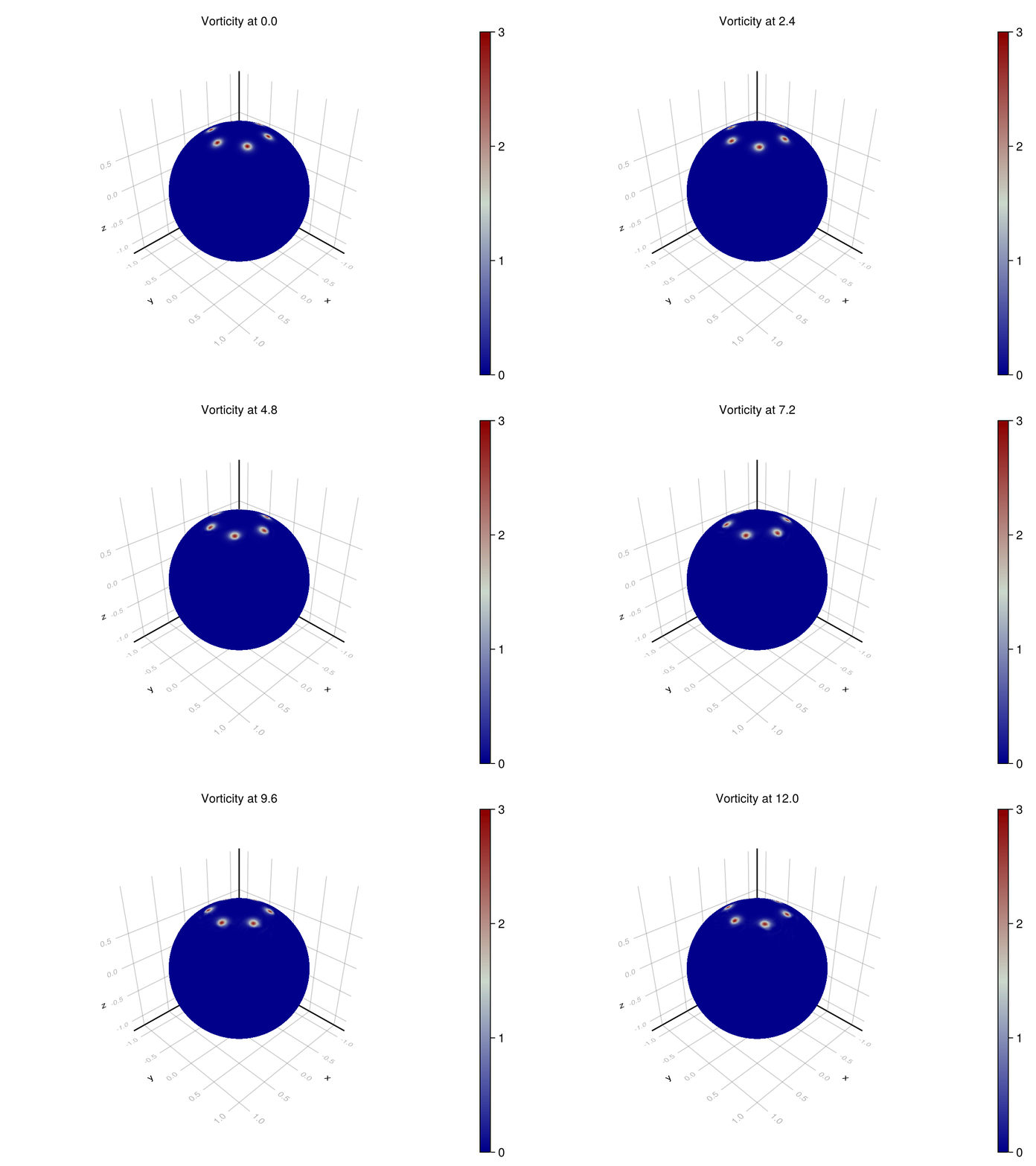
Point vortices spiraling Point vortices spiraling

Links:

Project team

PhotoNameMember sinceDegreeProgram
Luke Morris2021PhDCISE
Matt Cuffaro2023Research Software Engineer
George Rauta2022PhDCISE

Project articles

Decapodes: A diagrammatic tool for representing, composing, and computing spatialized partial differential equations

Luke Morris, Andrew Baas, Jesus Arias, Maia Gatlin, Evan Patterson, James P. FairbanksJournal of Computational Science2024

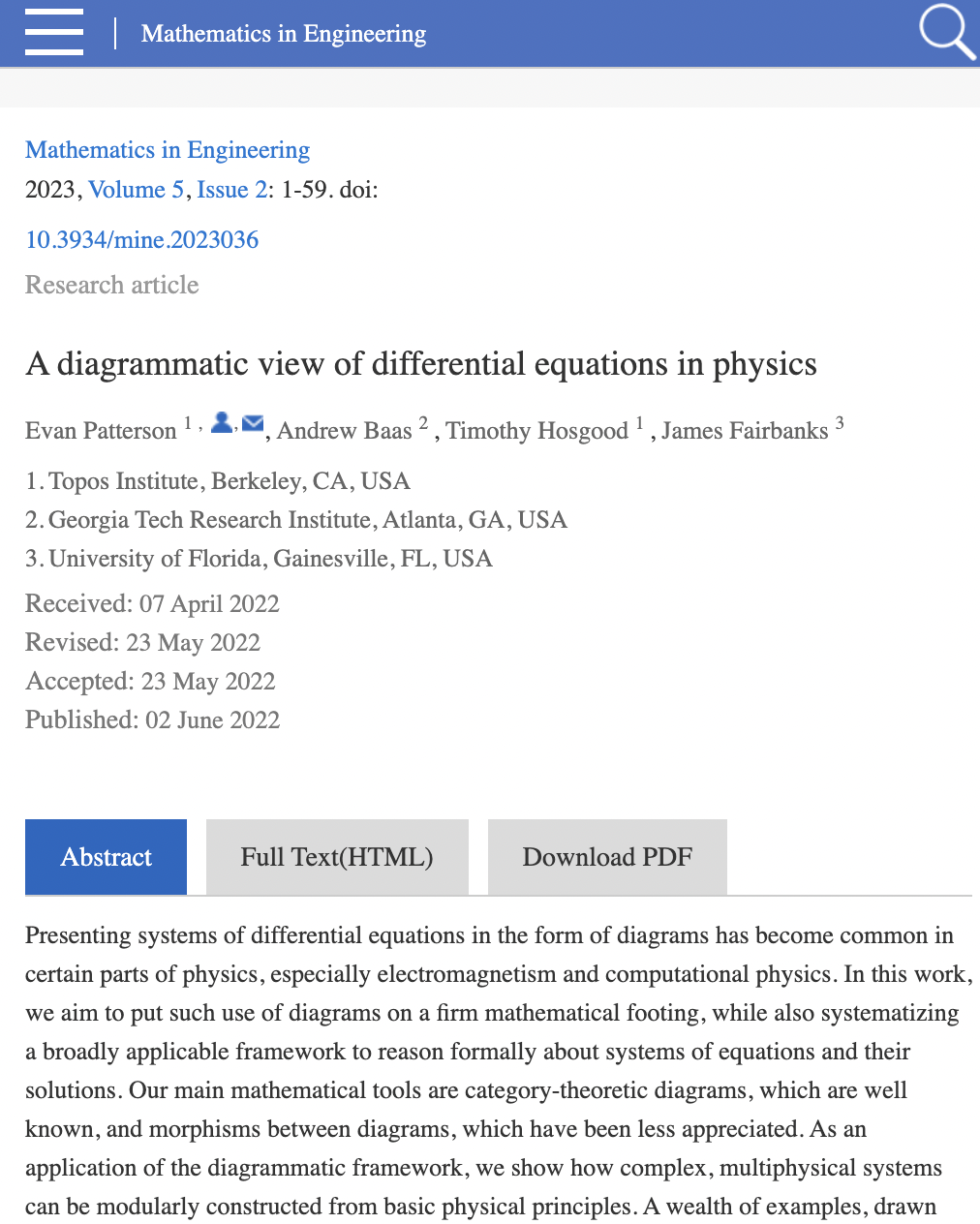
A diagrammatic view of differential equations in physics

Evan Patterson, Andrew Baas, Timothy Hosgood, James FairbanksMathematics in Engineering2022

A Diagrammatic Presentation of Equations in Categories

Kevin Arlin, James Fairbanks, Tim Hosgood, Evan PattersonarXiv2022

Subproject: general categorical equations

Project Leader: Kevin Carlson at the Topos Institute

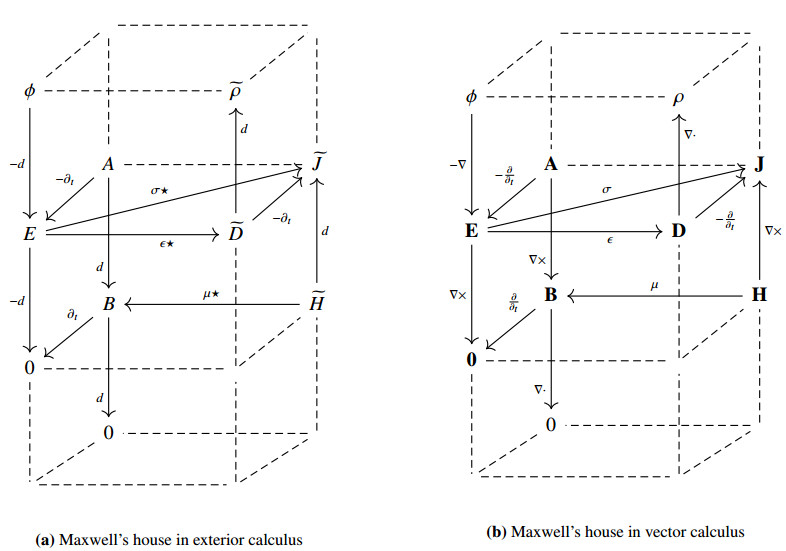
Diagrammatic Presentations of Equations Diagrammatic Presentations of Equations

Sponsors

DARPA

Decapodes has been supported by the following DARPA programs:

  • Automating Scientific Knowledge Extraction
  • Directly Computable Models
  • Automating Scientific Knowledge Extraction and Modeling

Algebraic Dynamics, Optimization, and Control

AlgebraicControl.jl

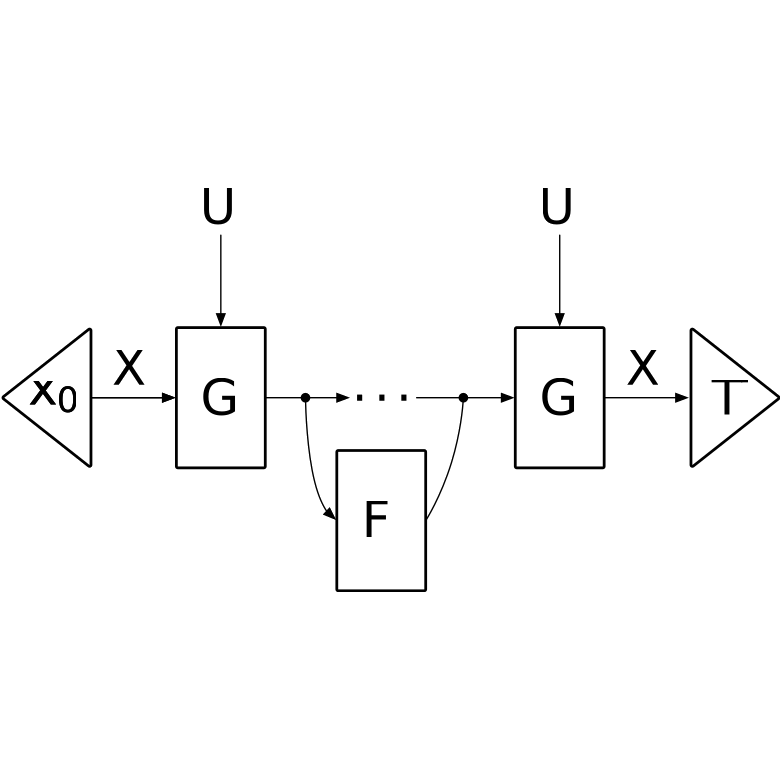
Model predictive control (MPC) is an optimal control technique which involves solving a sequence of constrained optimization problems across a given time horizon. We present a novel Julia library that leverages our theoretical results to automate the implementation of correct-by-construction MPC problems in software.

Project team

PhotoNameMember sinceDegreeProgram
Tyler Hanks2021PhDCISE
Samuel Cohen2024
Richard Samuelson2024PhD

Project articles

A Compositional Framework for First-Order Optimization

T. Hanks, M Klawonn, M Hale, E Patterson, JP FairbanksarxivSubmitted 2024

Generalized Gradient Descent is a Hypergraph Functor

T Hanks, M. Klawonn, J. FairbanksApplied Category TheorySubmitted March 2024

Modeling Model Predictive Control: A Category Theoretic Framework for Multistage Control Problems

Tyler Hanks, Baike She, Matthew Hale, Evan Patterson, Matthew Klawonn, James FairbanksAmerican Control ConferenceJul 2024

Characterizing Compositionality of LQR from the Categorical Perspective

Baike She, Tyler Hanks, James Fairbanks, Matthew HaleIEEE Conf. Decision and Control2023

An Algebraic Framework for Structured Epidemic Modeling

S. Libkind, A. Baas, M. Halter, E. Patterson, and J. P. FairbanksProc. of the Royal Society Phil. Trans.Aug 2022

Typed and stratified models with slice categories

S. Libkind (speaker), E. Patterson, A. Baas, M. Halter, J. FairbanksApplied Category Theory 2022Jul 2022

Operadic Modeling of Dynamical Systems: Mathematics and Computation

S. Libkind, A. Baas, E. J. Patterson, J. P. FairbanksApplied category Theory (Proceedings)Jul 2021

AlgebraicDynamics: Compositional dynamical systems

S. Libkind, J. P. FairbanksJuliaCon, OnlineJul 2021

Sponsors

National Science Foundation Office of Naval Research Air Force Research Laboratory

AlgebraicOptimization and Control has been supported by the following programs:

  • NSF: Graduate Research Fellowship Program
  • ONR: Domain Transfer for Continuity of Performance
  • AFRL: Griffis Summer Internship Program

Compositional Algorithms with Sheaves

StructuredDecompositions.jl

Project team

PhotoNameMember sinceDegreeProgram
Benjamin Merlin Bumpus2022PhDResearch Assistant Professor
Wilmer Leal2022PhDPostdoctoral Fellow

Project articles

Towards a Unified Theory of Time-varying Data

B. Bumpus, J. Fairbanks, M. Karvonen, W. Leal, F. SimardProc. of the Royal Society Phil. Trans.Submitted 2024

Compositional Algorithms on Compositional Data: Deciding Sheaves on Presheaves

E. Althaus, B. Bumpus, J. Fairbanks, D. RosiakFundamenta InformaticaeSubmitted 2024

How Nice is this Functor? Two Squares and Some Homology go a Long Way

B. Bumpus, D. Rosiak, C. Puca, F. Genovese, J. FairbanksApplied Category TheorySubmitted March 2024

Short Note on Cohomology, Sheafification and Lavish Presheaves

B. Bumpus, D. Rosiak, M. Cappucci, J. FairbanksApplied Category TheorySubmitted March 2024

Sponsors

DARPA

Computational sheaf theory has been supported by the DARPA program Automating Scientific Knowledge Extraction and Modeling.

Research

This page has tables of our research publications broken down by category.

Journal papers

YearTitleAuthorsJournalLink
2025Porous Convection in the Discrete Exterior Calculus with Geometric MultigridL. Morris, G. Rauta, K. Carlson, J. FairbanksArxivLink
2024Towards a Unified Theory of Time-varying DataB. Bumpus, J. Fairbanks, M. Karvonen, W. Leal, F. SimardArxivLink
2024A Compositional Framework for First-Order OptimizationT. Hanks, M Klawonn, M Hale, E Patterson, JP FairbanksArxivLink
2024Towards a Compositional Framework for Convex AnalysisR. Samuelson, D. SteinArxivLink
2024A compositional account of motifs, mechanisms, and dynamics in biochemical regulatory networksR. Aduddell, J. Fairbanks, A. Kumar, P.S. Ocal, E. Patterson, B.T. ShapiroCompositionalityLink
2024The Diagrammatic Presentation of Equations in CategoriesK. Arlin, J. Fairbanks, T. Hosgood, E. PattersonArxivLink
2024Compositional Algorithms on Compositional Data: Deciding Sheaves on PresheavesE. Althaus, B. Bumpus, J. Fairbanks, D. RosiakArxivLink
2023Decapodes: A Diagrammatic Tool for Representing, Composing, and Computing Spatialized Partial Differential EquationsL. Morris, A. Baas, J. Arias, M. Gaitlin, E. Patterson, J. FairbanksJournal of Computational ScienceLink
2023Computational Category-Theoretic RewritingK. Brown, E. Patterson, T. Hanks, J. FairbanksJ. Logical and Algebraic Methods in ProgrammingLink
2023The application of applied category theory to quantify mission successR. Garrett, J. Fairbanks, M. Loper, J. MorelandSIMULATION 99 (2) 201-220Link
2023A Compositional Framework for Convex Model Predictive ControlT. Hanks, B. She, M. Hale, E. Patterson, M. Klawonn, J. FairbanksArxivLink
2022An Algebraic Framework for Structured Epidemic ModelingS. Libkind, A. Baas, M. Halter, E. Patterson, and J. P. FairbanksProc. of the Royal Society Phil. Trans.Link
2022A Diagrammatic View of Differential Equations in PhysicsE. Patterson, A. Baas, T. Hosgood, J. P. FairbanksMathematics in EngineeringLink
2022Categorical Data Structures for Technical ComputingE. J. Patterson, O. Lynch, J. P. FairbanksCompositionalityLink
2021Category-theoretic formulation of the model-based systems architecting cognitive-computational CycleY. Mordecai, J. P. Fairbanks, E.F. CrawleyMDPI Applied Sciences 11 (4), 1945Link
2017Spectral Partitioning with Blends of EigenvectorsJ. P. Fairbanks, D. A. Bader, G. D. SandersJournal of Complex NetworksLink
2015Behavioral Clusters in Dynamic GraphsJ. P. Fairbanks, R. Kannan, H. Park, D. A. BaderParallel Computing Special Issue of Scientific Graph AnalysisLink
2011A Ramsey Theorem for Indecomposable MatchingsJ. P. FairbanksElectronic Journal of Combinatorics, Vol 18(1)Link

Conference papers

YearTitleAuthorsVenueLink
2024Generalized Gradient Descent is a Hypergraph FunctorT Hanks, M. Klawonn, J. FairbanksApplied Category Theory
2024How Nice is this Functor? Two Squares and Some Homology go a Long WayB. Bumpus, D. Rosiak, C. Puca, F. Genovese, J. FairbanksApplied Category Theory
2024Short Note on Cohomology, Sheafification and Lavish PresheavesB. Bumpus, D. Rosiak, M. Cappucci, J. FairbanksApplied Category Theory
2024GATlab: Modeling and Programming with Generalized Algebraic TheoriesO Lynch, K Brown, JP Fairbanks, and E Patterson.Mathematical Foundations of Programming SemanticsLink
2024Modeling Model Predictive Control: A Category Theoretic Framework for Multistage Control ProblemsTyler Hanks, Baike She, Matthew Hale, Evan Patterson, Matthew Klawonn, James FairbanksAmerican Control ConferenceLink
2023A Categorical Representation Language and Computational System for Knowledge-Based PlanningA. Aguinaldo, E. Patterson, J. Fairbanks and J. RuizAAAI Fall Symposium on Unifying Representations for Robot Application Development
2023Characterizing Compositionality of LQR from the Categorical PerspectiveBaike She, Tyler Hanks, James Fairbanks, Matthew HaleIEEE Conf. Decision and ControlLink
2022Compositional Exploration of Combinatorial Scientific ModelsK. Brown, T. Hanks, J. P. FairbanksApplied Category TheoryLink
2022Computational Category-Theoretic RewritingK. Brown, E. Patterson, T. Hanks, J. P. FairbanksInternational Conference on Graph Transformation (Best Paper Award)Link
2021Operadic Modeling of Dynamical Systems: Mathematics and ComputationS. Libkind, A. Baas, E. J. Patterson, J. P. FairbanksApplied category Theory (Proceedings)Link
2020SemanticModels.jl: A Julia Package for Scientific Model AugmentationM. Halter, S. Raparti, K. Cao, C. Herlihy, J. P. FairbanksProceedings of the JuliaCon Conferences
2019Constructing Knowledge Graphs from Scientific TextsK. Cao, J. P. FairbanksKDD workshop on Machine Learning in Graphs
2019A Compositional Framework for Scientific Model AugmentationM. Halter, C. Herlihy, J. P. FairbanksApplied Category TheoryLink
2019Semantic Program Analysis for Scientific Model AugmentationJ. P. Fairbanks, C. Herlihy, K. Cao, S. ReparthiModeling the World's Systems
2018Digital Witness: Remote Methods for Volunteering Digital Evidence on Mobile DevicesN. Campbell, T. Goodyear, W. Messer, E. Stuart, J. P. FairbanksIEEE Technologies for Homeland SecurityLink
2018Performance Effects of Backing Data Stores in Community Detection AlgorithmsR. Varkey Thankachan, B. P. Swenson, J. P. FairbanksIEEE High Performance Extreme ComputingLink
2018Credibility Assessment in the News: Do we need to read?N. Fitch, N. Knauf, J. P. Fairbanks, E. BriscoeACM WSDM MIS2Link
2017Integrating Productivity-Oriented Programming Languages with High-Performance Data StructuresR. Varkey Thankachan, E. Hein, B. P. Swenson, J. P. FairbanksIEEE High Performance Extreme ComputingLink
2017Deriving Streaming Graph Algorithms from Static DefinitionsJ. P. Fairbanks, D. M. EdigerIEEE International Parallel and Distributed Processing Graph Algorithms Building BlocksLink
2017Graph Partitioning with Spectral BlendsJ. P. Fairbanks, D. A. Bader, and G. D. SandersOxford Journal of Complex Networks
2017Ranking in Dynamic Graphs Using Exponential CentralityE. Nathan, J. P. Fairbanks, D. A. BaderInternational Conference on Complex Networks and their Applications
2017Graph Ranking Guarantees for Numerical Approximations to Katz CentralityE. Nathan, G. Sanders, J. P. Fairbanks, V. Henson and D. BaderInternational Conference On Computational Science
2017Deriving Streaming Graph Algorithms from Static Definitions.D. M. Ediger and J. P. FairbanksIEEE Parallel and Distributed Processing - Graph Algorithm Building Blocks
2016Novel Stopping Criteria for Spectral PartitioningJ. P. Fairbanks, A. Zakrzewska, D.A. BaderSIAM Network ScienceLink
2013A Statistical Framework for Analyzing Streaming GraphsJ. P. Fairbanks, D. Ediger, R. McColl, D.A. Bader, E. GilbertIEEE/ACM ASONAMLink
A local measure of community change in dynamic graphs.A. Zakrzewska, E. Nathan, J. P. Fairbanks, D. A. BaderIEEE/ACM ASONAM

Conference talks

YearTitleAuthorsVenueLink
2022Diagrammatic differential equations: Formal categorical framework and applications to multiphysics simulation,E. Patterson, T. Hosgood (speaker), A. Baas, J. FairbanksApplied Category Theory 2022
2022Typed and stratified models with slice categoriesS. Libkind (speaker), E. Patterson, A. Baas, M. Halter, J. FairbanksApplied Category Theory 2022
2022Individual.jl: Rewriting individual-based models for epidemiology using graph rewritingS. Wu (speaker), K. Browm, and J. FairbanksApplied Category Theory 2022
2021Accelerating Automatic Target Recognition Performance Evaluation with a Relational DatabaseM. Jackson, M. Halter, T. Goodyear, B. O’Donnell, and J. FairbanksTri-Service Radar Symposium
2021AlgebraicDynamics: Compositional dynamical systemsS. Libkind, J. P. FairbanksJuliaCon, OnlineLink
2021Shaped Data with AcsetsO. Lynch, E. J. Patterson, J. P. FairbanksJuliaCon, OnlineLink
2019SemanticModels.jl: Not Just Another Modeling FrameworkJ. P. Fairbanks and C. R. HerlihyJuliaCon, Baltimore, MDLink
2019Complex Systems Analysis of Hybrid WarfareM. Nadolski and J. P. FairbanksConference on Systems Engineering Research
2018The JuliaGraphs Ecosystem: Move Fast and Don't Break ThingsJ. P. FairbanksJuliaCon, London, UKLink
2017Assessing Credibility in Global Media NetworksJ. P. FairbanksHuman Language Technologies
2017Using Big Data to Predict and Analyze Cooperation and ConflictT. Frederick, C. Herlihy, J. P. FairbanksThe Conflict Conference at UT-Austin
2017LightGraphs: Our Network, Our StoryS. Bromberger, J. P. FairbanksJuliaCon, Berkeley, CALink
Graph Interfaces: Bespoke Graphs for Every OccasionM. Besan\c{c}on, J. P. FairbanksJuliaCon, London, UKLink

Subsections of Selected Papers

Decapodes: A diagrammatic tool for representing, composing, and computing spatialized partial differential equations

Abstract

We present Decapodes, a diagrammatic tool for representing, composing, and solving partial differential equations. Decapodes provides an intuitive diagrammatic representation of the relationships between variables in a system of equations, a method for composing systems of partial differential equations using an operad of wiring diagrams, and an algorithm for deriving solvers using hypergraphs and string diagrams. The string diagrams are in turn compiled into executable programs using the techniques of categorical data migration, graph traversal, and the discrete exterior calculus. The generated solvers produce numerical solutions consistent with state-of-the-art open source tools as demonstrated by benchmark comparisons with SU2. These numerical experiments demonstrate the feasibility of this approach to multiphysics simulation and identify areas requiring further development.

A diagrammatic view of differential equations in physics

Abstract

Presenting systems of differential equations in the form of diagrams has become common in certain parts of physics, especially electromagnetism and computational physics. In this work, we aim to put such use of diagrams on a firm mathematical footing, while also systematizing a broadly applicable framework to reason formally about systems of equations and their solutions. Our main mathematical tools are category-theoretic diagrams, which are well known, and morphisms between diagrams, which have been less appreciated. As an application of the diagrammatic framework, we show how complex, multiphysical systems can be modularly constructed from basic physical principles. A wealth of examples, drawn from electromagnetism, transport phenomena, fluid mechanics, and other fields, is included.

A Diagrammatic Presentation of Equations in Categories

Abstract

Lifts of categorical diagrams D:𝖩→𝖷 against discrete opfibrations π:𝖤→𝖷 can be interpreted as presenting solutions to systems of equations. With this interpretation in mind, it is natural to ask if there is a notion of equivalence of diagrams D≃D′ that precisely captures the idea of the two diagrams “having the same solutions”. We give such a definition, and then show how the localisation of the category of diagrams in 𝖷 along such equivalences is isomorphic to the localisation of the slice category 𝖢𝖺𝗍/𝖷 along the class of initial functors. Finally, we extend this result to the 2-categorical setting, proving the analogous statement for any locally presentable 2-category in place of 𝖢𝖺𝗍.

Publications

This list is the same data as the bibliography table, exported from Zotero and rendered in an APA-flavoured style.

Journal articles

  1. Morris, L., Baas, A., Arias, J., Gatlin, M., Patterson, E., & Fairbanks, J. P. (2024). Decapodes: A diagrammatic tool for representing, composing, and computing spatialized partial differential equations. Journal of Computational Science, 81, 102345. https://doi.org/10.1016/j.jocs.2024.102345
  2. Aduddell, R., Fairbanks, J., Kumar, A., Ocal, P. S., Patterson, E., & Shapiro, B. T. (2024). A compositional account of motifs, mechanisms, and dynamics in biochemical regulatory networks. Compositionality, 6, 2. https://doi.org/10.32408/compositionality-6-2
  3. Brown, K., Patterson, E., Hanks, T., & Fairbanks, J. (2023). Computational category-theoretic rewriting. Journal of Logical and Algebraic Methods in Programming, 134, 100888. https://doi.org/10.1016/j.jlamp.2023.100888
  4. Garrett, R. K., Fairbanks, J. P., Loper, M. L., & Moreland, J. D. (2023). The application of applied category theory to quantify mission success. Simulation, 99(2), 201–220. https://doi.org/10.1177/00375497221114861
  5. Patterson, E., Baas, A., Hosgood, T., & Fairbanks, J. (2023). A diagrammatic view of differential equations in physics. Mathematics in Engineering, 5(2), 1–59. https://doi.org/10.3934/mine.2023036
  6. Patterson, E., Lynch, O., & Fairbanks, J. (2022). Categorical Data Structures for Technical Computing. Compositionality, Volume 4 (2022). https://doi.org/10.32408/compositionality-4-5
  7. Libkind, S., Baas, A., Halter, M., Patterson, E., & Fairbanks, J. P. (2022). An algebraic framework for structured epidemic modelling. Philosophical Transactions of the Royal Society A: Mathematical, Physical and Engineering Sciences, 380(2233), 20210309. https://doi.org/10.1098/rsta.2021.0309
  8. Mordecai, Y., Fairbanks, J. P., & Crawley, E. F. (2021). Category-theoretic formulation of the model-based systems architecting cognitive-computational cycle. Applied Sciences, 11(4), 1945.
  9. Briscoe, E., & Fairbanks, J. (2020). Artificial scientific intelligence and its impact on national security and foreign policy. Orbis, 64(4), 544–554.
  10. Fairbanks, J. P., Bader, D. A., & Sanders, G. D. (2017). Spectral partitioning with blends of eigenvectors. Journal of Complex Networks, 5(4), 551–580.
  11. Fairbanks, J. P., Kannan, R., Park, H., & Bader, D. A. (2015). Behavioral clusters in dynamic graphs. Parallel Computing, 47, 38–50.
  12. Fairbanks, J. (2011). A Ramsey theorem for indecomposable matchings. arXiv:1110.3314.

Conference proceedings

  1. Hanks, T., Nino, C., Barcelo, J. B., Copeland, A., Dixon, W., & Fairbanks, J. (2026). Heterogeneous Multi-agent multi-target tracking using cellular sheaves. In European Control Conference. IEEE. (to appear).
  2. Zhao, Y., Hanks, T., Riess, H., Cohen, S., Hale, M., & Fairbanks, J. (2026). Asynchronous nonlinear sheaf diffusion for multi-agent coordination. In IEEE American Control Conference. IEEE. (accepted).
  3. Currier, K., Leal, W., Rauta, G., Copeland, A., Dixon, W., & Fairbanks, J. (2026). Whitney Control Barrier Functions: A Mesh-based Geometric approach via Discrete Exterior Calculus. In IFAC. (in press).
  4. Hanks, T., Riess, H., Cohen, S., Gross, T., Hale, M., & Fairbanks, J. (2025). Distributed Multi-agent Coordination over Cellular Sheaves. In IEEE Conference on Decision and Control. IEEE. https://doi.org/10.48550/arXiv.2504.02049
  5. Lary, M., Samuelson, R., Wilentz, A., Zare, A., Klawonn, M., & Fairbanks, J. (2025). Learning diagrams: a graphical language for compositional training regimes. In The thirteenth international conference on learning representations. https://openreview.net/forum?id=dqyuCsBvn9
  6. Hanks, T., She, B., Hale, M., Patterson, E., Klawonn, M., & Fairbanks, J. (2024). Modeling Model Predictive Control: A Category Theoretic Framework for Multistage Control Problems. In 2024 American Control Conference (ACC) (pp. 4850-4857). IEEE. https://doi.org/10.23919/ACC60939.2024.10644848
  7. Bumpus, B. M., Fairbanks, J., Genovese, F., Puca, C., & Rosiak, D. (2024). How nice is this functor? Two squares and some homology go a long way. Proceedings of Applied Category Theory, 2024.
  8. Lynch, O., Brown, K., Fairbanks, J., & Patterson, E. (2024). GATlab: Modeling and Programming with Generalized Algebraic Theories. In Electronic Notes in Theoretical Informatics and Computer Science. Episciences. org. https://oxford24.github.io/assets/mfps-papers/MFPS24-11.pdf
  9. She, B., Hanks, T., Fairbanks, J., & Hale, M. (2023). Characterizing Compositionality of LQR from the Categorical Perspective. In 2023 62nd IEEE Conference on Decision and Control (CDC) (pp. 1680-1685). https://doi.org/10.1109/CDC49753.2023.10383467
  10. Aguinaldo, A., Patterson, E., Fairbanks, J., Regli, W., & Ruiz, J. (2023). A Categorical Representation Language and Computational System for Knowledge-Based Robotic Task Planning [Best Paper Award]. In Proceedings of the AAAI Symposium Series (pp. 491-497). https://doi.org/10.1609/aaaiss.v2i1.27718
  11. Libkind, S., Baas, A., Patterson, E., & Fairbanks, J. (2022). Operadic Modeling of Dynamical Systems: Mathematics and Computation. Electronic Proceedings in Theoretical Computer Science, 372, 192-206. https://doi.org/10.4204/EPTCS.372.14
  12. Brown, K., Patterson, E., Hanks, T., & Fairbanks, J. (2022). Computational Category-Theoretic Rewriting [Best Paper]. In Graph Transformation: 15th International Conference, ICGT 2022, Held as Part of STAF 2022, Nantes, France, July 7–8, 2022, Proceedings (pp. 155–172). Springer-Verlag. https://doi.org/10.1007/978-3-031-09843-7_9
  13. Brown, K., Hanks, T., & Fairbanks, J. (2022). Compositional Exploration of Combinatorial Scientific Models. In Applied Category Theory. https://doi.org/10.48550/ARXIV.2206.08755
  14. Halter, M., Herlihy, C., & Fairbanks, J. (2020). A Compositional Framework for Scientific Model Augmentation. In Electronic Proceedings in Theoretical Computer Science (pp. 172-182). Opn Publishing Association. https://doi.org/10.4204/EPTCS.323.12
  15. Fairbanks, J. P., Fitch, N., Bradfield, F., & Briscoe, E. (2020). Credibility Development with Knowledge Graphs. In Lecture Notes in Computer Science (pp. 33-47). Springer International Publishing. https://doi.org/10.1007/978-3-030-39627-5_4
  16. Cao, K., & Fairbanks, J. (2019). Unsupervised Construction of Knowledge Graphs From Text and Code. In SIGKDD Conference on Knowledge Discovery and Data Mining International Workshop on Mining and Learning with Graphs. ACM.
  17. Nadolski, M., & Fairbanks, J. (2019). Complex systems analysis of hybrid warfare. Procedia Computer Science, 153, 210-217. https://doi.org/10.1016/j.procs.2019.05.072
  18. Campbell, N., Goodyear, T., Messer, W., Stuart, E., & Fairbanks, J. (2018). Digital Witness: Remote Method for Volunteering Digital Evidence on Mobile Devices. In 2018 IEEE International Symposium on Technologies for Homeland Security (HST) (pp. 1-5). IEEE. https://doi.org/10.1109/THS.2018.8574119
  19. Thankachan, R. V., Swenson, B. P., & Fairbanks, J. P. (2018). Performance Effects of Dynamic Graph Data Structures in Community Detection Algorithms. In 2018 IEEE High Performance extreme Computing Conference (HPEC) (pp. 1-7). IEEE. https://doi.org/10.1109/HPEC.2018.8547528
  20. Fairbanks, J. P., Fitch, N., Knauf, N., & Briscoe, E. (2018). Credibility Assessment in the News: Do We Need to Read? In WSDM/MIS2 (pp. 8). ACM. https://doi.org/10.1145/3159652.3160597
  21. Nathan, E., Fairbanks, J., & Bader, D. (2018). Ranking in Dynamic Graphs Using Exponential Centrality. In Complex Networks & Their Applications VI (pp. 378-389). Springer International Publishing. https://doi.org/10.1007/978-3-319-72150-7_31
  22. Thankachan, R. V., Hein, E. R., Swenson, B. P., & Fairbanks, J. P. (2017). Integrating productivity-oriented programming languages with high-performance data structures. In 2017 IEEE High Performance Extreme Computing Conference (HPEC) (pp. 1-8). IEEE. https://doi.org/10.1109/HPEC.2017.8091068
  23. Ediger, D., & Fairbanks, J. P. (2017). Deriving Streaming Graph Algorithms from Static Definitions. In 2017 IEEE International Parallel and Distributed Processing Symposium Workshops (IPDPSW) (pp. 637-642). IEEE. https://doi.org/10.1109/IPDPSW.2017.146
  24. Nathan, E., Sanders, G., Fairbanks, J., Henson, V. E., & Bader, D. A. (2017). Graph Ranking Guarantees for Numerical Approximations to Katz Centrality. Procedia Computer Science, 108, 68-78. https://doi.org/10.1016/j.procs.2017.05.021
  25. Fairbanks, J. P., Zakrzewska, A., & Bader, D. A. (2016). New stopping criteria for spectral partitioning. In 2016 IEEE/ACM International Conference on Advances in Social Networks Analysis and Mining (ASONAM) (pp. 25-32). IEEE. https://doi.org/10.1109/ASONAM.2016.7752209
  26. Zakrzewska, A., Nathan, E., Fairbanks, J., & Bader, D. A. (2016). A local measure of community change in dynamic graphs. In 2016 IEEE/ACM International Conference on Advances in Social Networks Analysis and Mining (ASONAM) (pp. 349-353). IEEE. https://doi.org/10.1109/ASONAM.2016.7752257
  27. Fairbanks, J., Ediger, D., McColl, R., Bader, D. A., & Gilbert, E. (2013). A statistical framework for streaming graph analysis. In 2013 IEEE/ACM International Conference on Advances in Social Networks Analysis and Mining (ASONAM 2013) (pp. 341-347). https://doi.org/10.1145/2492517.2492620

Talks and conference talks

  1. Fairbanks, J. (2025). Modeling with ACT for Compositional Decision Making [Talk]. American Control Conference, Denver, CO.
  2. Fairbanks, J., & Patterson, E. (2025). Compositional Development of Compositional Mathematics [Talk]. Applied Category Theory, Gainesville, FL.
  3. Carlson, K. (2025). Multigrid Methods for Structure Preserving Discretizations [Talk]. 22ND Copper Mountain Conference on Multigrid Methods, Copper Mountain, CO.
  4. Fairbanks, J. P., Aduddell, R., Kumar, A., Ocal, P. S., Patterson, E., & Shapiro, B. T. (2024). A compositional account of motifs, mechanisms, and dynamics in biochemical regulatory networks. AMS Southeastern Sectional Meeting, Tallahassee, FL.
  5. Fairbanks, J. P., & Lynch, O. (2023). Computational category theory in applied mathematics [Invited]. Joint Mathematics Meetings, Boston, MA.
  6. Aduddell, R., Ocal, P. S., Fairbanks, J. P., Patterson, E., Shapiro, B., & Kumar, A. (2023). A categorical framework for (gene) regulatory networks. Joint Mathematics Meeting, Boston, MA.
  7. Patterson, E., Hosgood, T., Baas, A., & Fairbanks, J. (2022). Diagrammatic differential equations: Formal categorical framework and applications to multiphysics simulation. Applied Category Theory, Glasgow, UK. https://doi.org/10.3934/mine.2023036
  8. Libkind, S., Baas, A., Halter, M., Patterson, E., & Fairbanks, J. (2022). Typed and stratified models with slice categories. In Applied Category Theory (pp. 1-3). https://msp.cis.strath.ac.uk/act2022/papers/ACT2022_paper_3530.pdf
  9. Wu, S. L., Libkind, S., Brown, K., Patterson, E., & Fairbanks, J. (2022). Individual. jl: Rewriting individual-based models for epidemiology using graph rewriting [Extended abstract]. Applied Category Theory, Glasgow, UK. https://msp.cis.strath.ac.uk/act2022/papers/ACT2022_paper_3642.pdf
  10. Jackson, M., Halter, M., Goodyear, T., O’Donnell, B., & Fairbanks, J. (2021). Accelerating automatic target recognition performance evaluation with a relational database. Tri-Service Radar Symposium.
  11. Lynch, O., Patterson, E., & Fairbanks, J. (2021). Shaped data with acsets. JuliaCon, Virtual. https://pretalx.com/juliacon2021/talk/NWRPGY/
  12. Libkind, S., & Fairbanks, J. (2021). AlgebraicDynamics: Compositional dynamical systems. JuliaCon, Virtual. https://pretalx.com/juliacon2021/talk/ARURL8/
  13. Halter, M., Patterson, E., Baas, A., & Fairbanks, J. (2020). Compositional Scientific Computing with Catlab and SemanticModels. In Applied Category Theory. http://arxiv.org/abs/2005.04831
  14. Halter, M., Raparti, S., Cao, K., Herlihy, C., & Fairbanks, J. (2020). SemanticModels. jl: a julia package for scientific model augmentation. In Proceedings of the JuliaCon conferences (pp. 57).
  15. Herlihy, C., & Fairbanks, J. (2019). semanticmodels.jl: Not just another modeling framework. JuliaCon, Baltimore, MD. https://www.youtube.com/watch?v=WJneK7OjqMQ
  16. Herlihy, C., Cao, K., Reparti, S., Briscoe, E., & Fairbanks, J. (2019). Semantic Program Analysis for Scientific Model Augmentation. Modeling the World’s Systems, 7.
  17. Fairbanks, J. (2018). The JuliaGraphs ecosystem: Move fast and don't break things. JuliaCon, London, UK. https://youtu.be/OZuQoxTPoyM
  18. Besançon, M., & Fairbanks, J. (2018). Graph interfaces: Bespoke graphs for every occasion. JuliaCon, London, UK. https://youtu.be/OD-BSn4FZ2A
  19. Bromberger, S., & Fairbanks, J. (2017). LightGraphs: Our network, our story. JuliaCon, Berkeley, CA. https://youtu.be/MFD-qmApXl8
  20. Frederick, T., Herlihy, C., & Fairbanks, J. (2017). Using big data to predict and analyze cooperation and conflict. The Conflict Conference, University of Texas, Austin, TX.
  21. Fairbanks, J., Knauf, N., Fitch, N., Herlihy, C., & Briscoe, E. (2017). Assessing credibility in the global news media. http://resources.basistech.com.s3.amazonaws.com/hltcon-presentations/2017/Fairbanks_Georgia_Tech_HLTCon.pdf
  22. Bader, D., Michalewicz, A., Green, O., Birkett-Rees, J., Riedy, J., Fairbanks, J., & Zakrzewska, A. (2016). Semantic database applications at the samtavro cemetery, georgia. In The 44th Computer Applications and Quantitative Methods in Archaeology Conference (CAA). Archaeopress. https://2016.caaconference.org/session-11-supporting-researchers-in-the-use-and-re-use-of-archaeological-data-continuing-the-ariadne-thread/

Posters

  1. Perez, J., Baas, A., Ferrall-Fairbanks, M. C., Platt, M. O., & Fairbanks, J. P. (2021). Parameter estimation by minimizing the loss with respect to a finite difference approximation on the vector field. Biomedical Engineering Society Annual Meeting, Orlando, FL.
  2. Lynch, O., Fairbanks, J. P., & Patterson, E. (2021). Graphical semantic modeling with semagrams.jl. Applied Category Theory, Cambridge, UK.
  3. Fairbanks, J. P. (2019). Semantic model understanding for scientific model augmentation. Systems Biology of Human Disease,, Berlin, DE.
  4. Fairbanks, J. P. (2017). QueryGarden: growing healthy applications in well prepared SQL. OHDSI Symposium, New York, NY.
  5. Brown, C. S., Duke, J., Fairbanks, J. P., Herlihy, C., Mukadam, K., Poovey, J., & Rost, M. (2017). Implementing real-time patient level predictions using PLP models. OHDSI Symposium.
  6. Fairbanks, J. P. (2015). Discovering block structure with approximate eigenvectors. SIAM Computational Science and Engineering.
  7. Fairbanks, J., & Sanders, G. (2015). Discovering block structure in graphs with approximate eigenvectors [Poster]. SIAM Computational Science and Engineering, Salt Lake City, UT. https://jpfairbanks.com/doc/siam-cse-2015.pdf
  8. Fairbanks, J. P. (2012). Ramsey theorem for indecomposable matchings. Graph Theory at Georgia Tech (GT@GT), Atlanta, GA.

Preprints

  1. Bumpus, B. M., Fairbanks, J., & Turner, W. J. (2024). Pushing Tree Decompositions Forward Along Graph Homomorphisms. arXiv. https://doi.org/10.48550/arXiv.2408.15184
  2. Hanks, T., Klawonn, M., Patterson, E., Hale, M., & Fairbanks, J. (2024). A Compositional Framework for First-Order Optimization. arXiv. https://doi.org/10.48550/arXiv.2403.05711
  3. Arlin, K., Fairbanks, J., Hosgood, T., & Patterson, E. (2024). The diagrammatic presentation of equations in categories. arXiv:2401.09751.
  4. Bumpus, B. M., Capucci, M., Fairbanks, J., & Rosiak, D. (2024). Failures of compositionality: a short note on cohomology, sheafification and lavish presheaves. arXiv:2407.03488.
  5. Althaus, E., Bumpus, B. M., Fairbanks, J., & Rosiak, D. (2023). Compositional Algorithms on Compositional Data: Deciding Sheaves on Presheaves. arXiv. https://doi.org/10.48550/arXiv.2302.05575

Talks, extremely comprehensive list

  1. Fairbanks, J. P. (2026). Compositional Modeling: Structures, Dynamics, Optimization. American Control Conference, New Orleans, LA.
  2. Fairbanks, J. P. (2026). Panel on Applied Category Theory for Compositional Decision Making. American Control Conference, New Orleans, LA.
  3. Rauta, G., Fairbanks, J. P., & Kuzendorf, W. (2026). Low-Mach Compressible Navier-Stokes Using Discrete Exterior Calculus on Rectilinear Grids. WCCM-ECCOMAS [accepted], Munich, Germany.
  4. Cohen, S., & Fairbanks, J. P. (2026). Federated Learning with Cellular Sheaves. UF Undergraduate Research Symposium, Gainesville, FL.
  5. Hanks, T., Reiss, H., Cohen, S., Gross, T., Hale, M., & Fairbanks, J. P. (2026). Distributed Multi-Agent Coordination over Cellular Sheaves. AMS Special Session on Applied Category Theory Joint Mathematics Meeting, Washington DC.
  6. Gross, T., & Fairbanks, J. P. (2026). Quadrotor Coordination Using Cellular Sheaves and Linearized LQR. Center for Undergraduate Research Spring Symposium, Gainesville, FL, USA.
  7. Bou Barcelo, J., & Fairbanks, J. P. (2026). Heterogeneous Multi-Agent Multi-Target Tracking. INFORMS Optimization Society Conference, Atlanta, GA.
  8. Hanks, T., Klawonn, M., Patterson, E., Hale, M., & Fairbanks, J. P. (2026). Categorical Foundations of Distributed Optimization and Learning. AMS Special Session on Mathematical Foundation of Machine Learning, Joint Mathematics Meeting, Washington DC.
  9. Hanks, T., & Fairbanks, J. P. (2026). Coordination Sheaves. Core Lab Georgia Tech, Atlanta.
  10. Fairbanks, J. P., & Zare, A. (2025). Domain Transfer for Continuity of Performance Across SAS Systems ​. ONR Code 32 Program Review, Online.
  11. Fairbanks, J. P., & Leal, W. (2025). Sheaves in Time Varying Data and Dynamical Systems. NCR Lab UF MAE Department, Gainesville, FL.
  12. Leal, W., & Fairbanks, J. P. (2025). Sheaves in Dynamical Systems: Enumerating Fixed Points of CTLNs. Kallies Research Group, Toledo, OH.
  13. Fairbanks, J. P. (2025). Building Modeling and Simulation Tools on Discrete Exterior Calculus Foundations. IMSI workshop on Discrete Exterior Calculus Differential Geometry and Applications, Chicago, Ill.
  14. Fairbanks, J. P., & Leal, W. (2025). Computing Fixed Points of CTLNs with Separated Presheaves, Sheaves and Dynamic Programming. Category Theory Octoberfest 2025, Online.
  15. Wall, A., & Fairbanks, J. P. (2025). A Category-Theoretic Approach to Resource Optimization. University Mathematics Society, Gainesville, FL.
  16. Fairbanks, J. P., & Leal, W. (2025). Sheaf Cohomology on Simplicial Complexes. CODAC COE, Gainesville, FL.
  17. Leal, W. (2025). Temporal Analysis of Data Using Category Theory and the Hidden Connection Between Persistence and Accumulation. Seminario de Matemáticas Aplicadas, Quantil, Colombia.
  18. Fairbanks, J. P. (2025). Going beyond graphs: simplicial, hyper, and relational structure. JuliaCon, Pittsburgh.
  19. Fairbanks, J. P. (2025). New Approaches in Computational Physics: Multiphysics and Multiscale with Discrete Exterior Calculus. Army Research Lab, Adelphi, MD.
  20. Fairbanks, J. P. (2025). Introduction to Applied Category Theory for Compositional Decision Making. ACC Conference Workshop, Denver, CO.
  21. Fairbanks, J. P. (2025). Compositional Modeling in Applied Category Theory for Compositional Decision Making. ACC Conference Workshop, Denver, CO.
  22. Rauta, G., & Fairbanks, J. P. (2025). Modeling of Coupled Weakly Compressible Navier-Stokes and Thermal Equation in the Discrete Exterior Calculus. Army Research Lab Poster Session, Adelphi, MD.
  23. Hanks, T., & Fairbanks, J. P. (2025). Category Theory for Distributed Optimization. Applied Category Theory [keynote], Gainesville, FL.
  24. Zelko, J., Cuffaro, M., Wu, S., & Fairbanks, J. P. (2025). A Case Study in Public Health Research. Applied Category Theory, Gainesville, FL.
  25. Fairbanks, J. P., & Patterson, E. (2025). AlgebraicJulia Compositional Development of Compositional Mathematics. Applied Category Theory, Gainesville, FL.
  26. Hanks, T., & Fairbanks, J. P. (2025). Multiagent Autonomy with Cellular Sheaves. GTRI ACAI, Atlanta, GA.
  27. Wall, A., & Fairbanks, J. P. (2025). Structured Decompositions. Undergraduate Mathematics Research Symposium, Gainesville, FL.
  28. Fairbanks, J. P., & Kim, N. (2025). T6: Validation, Uncertainty Quantification, Uncertainty Budget, Workflow and Data Management. CM3C: Center for Multiscale Modeling of Multiphase Combustion, Gainesville, FL.
  29. Fairbanks, J. P. (2024). A compositional account of motifs, mechanisms, and dynamics in biochemical regulatory networks. AMS Southeastern Sectional Meeting, Tallahassee, FL.
  30. Morris, L. L., Baas, A., Fairbanks, J. P., Arias, J., & Gaitlin, M. (2023). Abstraction and Composition in Modeling and Simulation. Mechanical and Aerospace Engineering Seminar, Gainesville, FL.
  31. Morris, L., & Nathan, E. (2023). Discourse Sheaves for Opinion Dynamics over Social Media Data. Lawrence Livermore National Laboratory Summer SLAM, Livermore, CA.
  32. Libkind, S., Bumpus, B. M., Garcia, J. L., Sorkatti, L. H., & Tenka, S. (2023). Additive Invariants of Open Petri Nets. Applied Category Theory, College Park, MD.
  33. Lynch, O., Brown, K., Fairbanks, J. P., & Patterson, E. (2023). Gatlab. jl: Symbolic computing with categories using generalized algebraic theories. Applied Category Theory, College Park, MD.
  34. Bumpus, B. M., Fairbanks, J. P., Rosiak, D., & Althaus, E. (2023). Compositional Algorithms on Compositional Data: Deciding Sheaves on Presheaves. Applied Category Theory, College Park, MD.
  35. Fairbanks, J. P., Hanks, T. E., She, B., Patterson, E., Hale, M., & Klawonn, M. (2023). A Compositional Framework for Convex Model Predictive Control. Applied Category Theory, College Park, MD.
  36. Fairbanks, J. P., Morris, L. L., & Rauta, G. (2023). Computational Multiphysics in a Categorical Framework. Applied Category Theory, College Park, MD.
  37. Fairbanks, J. P., Hanks, T., She, B., Hale, M., Patterson, E., & Klawonn, M. (2023). A Compositional Framework for Model Predictive Control. AFOSR Center of Excellence Program Review, Gainesville, FL.
  38. Fairbanks, J. P. (2023). Decapodes. jl: A Framework for Multiphysics Simulation. MAE Department AFOSR Visit, Gainesville, FL.
  39. Morris, L. L., Baas, A., Fairbanks, J. P., Arias, J., & Gaitlin, M. (2023). Abstraction and Composition in Modeling and Simulation. SIAM Conference on Computational Science and Engineering, Amsterdam, NL.
  40. Fairbanks, J. P., Morris, L. L., & Rauta, G. (2023). Categorical Composition of Discrete Exterior Calculus Climate Models. Programming for the Planet (PROPL) at POPL, London, UK.
  41. Bumpus, B. M. (2023). Chopping things up to decide stuff fast. International seminar series on applications of category theory to finite model theory and computer science, Nottingham, United Kingdom.
  42. Bumpus, B. M., & Fairbanks, J. P. (2023). Chopping things up to decide stuff fast. 54th Southeastern International Conference on Combinatorics Graph Theory and Computing, Boca Raton, FL.
  43. Morris, L. L., Baas, A., Fairbanks, J. P., Arias, J., & Gaitlin, M. (2023). Abstraction and Composition in Modeling and Simulation. Graduate Mathematics Association, Gainesville, FL.
  44. Fairbanks, J. P. (2022). Scientific and Engineering Modeling with Applied Category Theory. DARPA Young Faculty Colloquium, Arlington, VA.
  45. Fairbanks, J. P., & Patterson, E. (2022). Enkix Task Reasoning. DARPA Site Visit, Gainesville, FL.
  46. Fairbanks, J. P. (2022). Computational Physics Modeling with Categories. Institute of Theoretical Physics, Friedric-Alexander-Universitaet, Erlangen-Nuernberg, Germany.
  47. Libkind, S., & Fairbanks, J. P. (2022). Compositional Modeling of Disease Dynamics. UW-IHME Compositional Epidemiology Modeling Working Group, Online.
  48. Fairbanks, J. P. (2022). Using Category Theory to Design Computational Mathematics Software. Numerical Analysis Seminar at UF Mathematics Department, Gainesville, FL.
  49. Fairbanks, J. P. (2022). Scientific and Engineering Modeling with Applied Category Theory. MAE Department Control Theory Working Group, Gainesville, FL.
  50. Fairbanks, J. P. (2022). Applied Category Theory for the Mathematics of Disease. Canadian Network for Modeling Infectious Disease, Vancouver, Canada.
  51. Fairbanks, J. P., & Patterson, E. (2022). Enkix Task Reasoning. DARPA Site Visit, Gainesville, FL.
  52. Hanks, T. (2022). Compositional Convex Optimization. Air Force Research Laboratory, Rome, NY.
  53. Fairbanks, J. P. (2022). Diagrammatic Equations in Physics: Directly Computable Models. Lawrence Livermore National Laboratory Center for Applied Scientific Computing, Livermore, CA.
  54. Fairbanks, J. P. (2022). Model Aware Scientific Computing with Categories. Air Force Research Laboratory, Rome, NY.
  55. Fairbanks, J. P. (2022). Diagrammatic Equations for Complex Machine Learning Formulations. ONR Code 32 Site Visit, Gainesville, FL.
  56. Fairbanks, J. P. (2022). Introduction to Category Theory. The Simula Corporation, Oslo, NO.
  57. Fairbanks, J. P. (2022). Diagrammatic Equations In Physics, Directly Computable Models. The Simula Corporation, Oslo, NO.
  58. Fairbanks, J. P. (2022). Computational Modeling with Category Theory. Systems Medicine Laboratory Seminar UF College of Medicine, Gainesville, FL.
  59. Fairbanks, J. P. (2022). Scientific Modeling with AlgebraicJulia. Rel.AI Research Seminar, Online.
  60. Fairbanks, J. P., & Lynch, O. (2022). Computational Category Theory in Applied Mathematics. Joint Mathematics Meetings, Boston, MA.
  61. Fairbanks, J. P., Aduddell, R., Ocal, P. S., Patterson, E., Shapiro, B., & Kumar, A. (2022). A Categorical Framework for (Gene) Regulatory Networks. Joint Mathematics Meeting, Boston, MA.
  62. Bumpus, B. M., & Fairbanks, J. P. (2022). Structured Decompositions: Recursive Data and Recursive Algorithms. Joint Math Meeting, Boston, MA.
  63. Brown, K., & Fairbanks, J. P. (2022). Automated Model Space Exploration. UW-IHME Compositional Epidemiology Modeling Working Group, Online.
  64. Fairbanks, J. P., Perez, J., Baas, A., Ferrall-Fairbanks, M., & Platt, M. O. (2021). Parameter Estimation by Minimizing the Loss with Respect to a Finite Difference Approximation on the Vector Field. Biomedical Engineering Society Annual Meeting, Orlando, FL.
  65. Lynch, O., Patterson, E., & Fairbanks, J. P. (2021). Shaped Data with ACSets. JuliaCon, Online.
  66. Libkind, S., Patterson, E., & Fairbanks, J. P. (2021). Shaped Data with ACSets. JuliaCon, Online.
  67. Fairbanks, J. P., & Patterson, E. (2021). Compositional Modeling with AlgebraicJulia. NIH Interagency Modeling and Analysis Group, Online.
  68. Fairbanks, J. P. (2021). The AlgebraicJulia Ecosystem: a Categorical Approach to Technical Computing. Topos Institute Berkeley Seminar, Berkeley, CA.
  69. Fairbanks, J. P. (2021). Computational Categorical Algebra with Catlab. Graph Transformation Theory and Applications, Paris, FR.
  70. Fairbanks, J. P. (2021). Progress towards the GroMet specification for semantic model exchange. DARPA Automating Scientific Knowledge Extraction Principal Investigator Meeting, Arlington, VA.
  71. Fairbanks, J. P. (2021). Generalized Algebraic Theories for Enhancing Multiphysics: An Introductory Deep Dive. DARPA Directly Computable Models Program Review, Arlington, VA.
  72. Fairbanks, J. P. (2021). Categorical Scientific Knowledge Representation. DARPA Automating Scientific Knowledge Extraction Stakeholder Workshop, Arlington, VA.
  73. Fairbanks, J. P. (2021). Model Aware Computing with Scientific Categories. DARPA Young Investigator Award Principal Investigator Meeting, Arlington, VA.
  74. Fairbanks, J. P. (2021). Introduction to the AlgebraicJulia Software Ecosystem. UF CISE - LLNL Advisory Board Annual Meeting, Gainesville, FL.
  75. Fairbanks, J. P. (2020). Rethinking Set Theory and Computational Mathematics. Undergraduate Math Society, Gainesville, FL.

Subsections of Full Bibliography

Bibliography Table

This is the same bibliography data as the publications list, collapsed into a single sortable table. Click a column header to sort; use the box to filter.

YearKindAuthorsTitleVenueLink
2026Conference paperHanks, T., Nino, C., Barcelo, J. B., Copeland, A., Dixon, W., & Fairbanks, J.Heterogeneous Multi-agent multi-target tracking using cellular sheavesEuropean Control Conference (to appear)
2026Conference paperZhao, Y., Hanks, T., Riess, H., Cohen, S., Hale, M., & Fairbanks, J.Asynchronous nonlinear sheaf diffusion for multi-agent coordinationIEEE American Control Conference (accepted)
2026TalkFairbanks, J. P.Compositional Modeling: Structures, Dynamics, OptimizationAmerican Control Conference
2026TalkFairbanks, J. P.Panel on Applied Category Theory for Compositional Decision MakingAmerican Control Conference
2026TalkRauta, G., Fairbanks, J. P., & Kuzendorf, W.Low-Mach Compressible Navier-Stokes Using Discrete Exterior Calculus on Rectilinear GridsWCCM-ECCOMAS [accepted]
2026TalkCohen, S., & Fairbanks, J. P.Federated Learning with Cellular SheavesUF Undergraduate Research Symposium
2026TalkHanks, T., Reiss, H., Cohen, S., Gross, T., Hale, M., & Fairbanks, J. P.Distributed Multi-Agent Coordination over Cellular SheavesAMS Special Session on Applied Category Theory Joint Mathematics Meeting
2026TalkGross, T., & Fairbanks, J. P.Quadrotor Coordination Using Cellular Sheaves and Linearized LQRCenter for Undergraduate Research Spring Symposium, Gainesville
2026TalkBou Barcelo, J., & Fairbanks, J. P.Heterogeneous Multi-Agent Multi-Target TrackingINFORMS Optimization Society Conference
2026TalkHanks, T., Klawonn, M., Patterson, E., Hale, M., & Fairbanks, J. P.Categorical Foundations of Distributed Optimization and LearningAMS Special Session on Mathematical Foundation of Machine Learning
2026TalkHanks, T., & Fairbanks, J. P.Coordination SheavesCore Lab Georgia Tech
2026Conference paperCurrier, K., Leal, W., Rauta, G., Copeland, A., Dixon, W., & Fairbanks, J.Whitney Control Barrier Functions: A Mesh-based Geometric approach via Discrete Exterior CalculusIFAC (in press)
2025TalkFairbanks, J. P., & Zare, A.Domain Transfer for Continuity of Performance Across SAS Systems ​ONR Code 32 Program Review
2025TalkFairbanks, J. P., & Leal, W.Sheaves in Time Varying Data and Dynamical SystemsNCR Lab UF MAE Department
2025TalkLeal, W., & Fairbanks, J. P.Sheaves in Dynamical Systems: Enumerating Fixed Points of CTLNsKallies Research Group
2025TalkFairbanks, J. P.Building Modeling and Simulation Tools on Discrete Exterior Calculus FoundationsIMSI workshop on Discrete Exterior Calculus Differential Geometry and Applications
2025TalkFairbanks, J. P., & Leal, W.Computing Fixed Points of CTLNs with Separated Presheaves, Sheaves and Dynamic ProgrammingCategory Theory Octoberfest 2025
2025TalkWall, A., & Fairbanks, J. P.A Category-Theoretic Approach to Resource OptimizationUniversity Mathematics Society
2025TalkFairbanks, J. P., & Leal, W.Sheaf Cohomology on Simplicial ComplexesCODAC COE
2025TalkLeal, W.Temporal Analysis of Data Using Category Theory and the Hidden Connection Between Persistence and AccumulationSeminario de Matemáticas Aplicadas
2025TalkFairbanks, J. P.Going beyond graphs: simplicial, hyper, and relational structureJuliaCon
2025TalkFairbanks, J. P.New Approaches in Computational Physics: Multiphysics and Multiscale with Discrete Exterior CalculusArmy Research Lab
2025TalkFairbanks, J. P.Introduction to Applied Category Theory for Compositional Decision MakingACC Conference Workshop
2025TalkFairbanks, J. P.Compositional Modeling in Applied Category Theory for Compositional Decision MakingACC Conference Workshop
2025TalkRauta, G., & Fairbanks, J. P.Modeling of Coupled Weakly Compressible Navier-Stokes and Thermal Equation in the Discrete Exterior CalculusArmy Research Lab Poster Session
2025TalkFairbanks, J.Modeling with ACT for Compositional Decision MakingAmerican Control Conference
2025TalkFairbanks, J., & Patterson, E.Compositional Development of Compositional MathematicsApplied Category Theory
2025TalkHanks, T., & Fairbanks, J. P.Category Theory for Distributed OptimizationApplied Category Theory [keynote]
2025TalkZelko, J., Cuffaro, M., Wu, S., & Fairbanks, J. P.A Case Study in Public Health ResearchApplied Category Theory
2025TalkFairbanks, J. P., & Patterson, E.AlgebraicJulia Compositional Development of Compositional MathematicsApplied Category Theory
2025TalkHanks, T., & Fairbanks, J. P.Multiagent Autonomy with Cellular SheavesGTRI ACAI
2025TalkWall, A., & Fairbanks, J. P.Structured DecompositionsUndergraduate Mathematics Research Symposium
2025TalkCarlson, K.Multigrid Methods for Structure Preserving Discretizations22ND Copper Mountain Conference on Multigrid Methods
2025Conference paperHanks, T., Riess, H., Cohen, S., Gross, T., Hale, M., & Fairbanks, J.Distributed Multi-agent Coordination over Cellular SheavesIEEE Conference on Decision and ControlLink
2025TalkFairbanks, J. P., & Kim, N.T6: Validation, Uncertainty Quantification, Uncertainty Budget, Workflow and Data ManagementCM3C: Center for Multiscale Modeling of Multiphase Combustion
2025Conference paperLary, M., Samuelson, R., Wilentz, A., Zare, A., Klawonn, M., & Fairbanks, J.Learning diagrams: a graphical language for compositional training regimesThe thirteenth international conference on learning representationsLink
2024PreprintBumpus, B. M., Fairbanks, J., & Turner, W. J.Pushing Tree Decompositions Forward Along Graph HomomorphismsarXivLink
2024Journal articleMorris, L., Baas, A., Arias, J., Gatlin, M., Patterson, E., & Fairbanks, J. P.Decapodes: A diagrammatic tool for representing, composing, and computing spatialized partial differential equationsJournal of Computational ScienceLink
2024Journal articleAduddell, R., Fairbanks, J., Kumar, A., Ocal, P. S., Patterson, E., & Shapiro, B. T.A compositional account of motifs, mechanisms, and dynamics in biochemical regulatory networksCompositionalityLink
2024TalkFairbanks, J. P.A compositional account of motifs, mechanisms, and dynamics in biochemical regulatory networksAMS Southeastern Sectional Meeting
2024Conference paperHanks, T., She, B., Hale, M., Patterson, E., Klawonn, M., & Fairbanks, J.Modeling Model Predictive Control: A Category Theoretic Framework for Multistage Control Problems2024 American Control Conference (ACC)Link
2024PreprintHanks, T., Klawonn, M., Patterson, E., Hale, M., & Fairbanks, J.A Compositional Framework for First-Order OptimizationarXivLink
2024TalkFairbanks, J. P., Aduddell, R., Kumar, A., Ocal, P. S., Patterson, E., & Shapiro, B. T.A compositional account of motifs, mechanisms, and dynamics in biochemical regulatory networksAMS Southeastern Sectional Meeting
2024Conference paperBumpus, B. M., Fairbanks, J., Genovese, F., Puca, C., & Rosiak, D.How nice is this functor? Two squares and some homology go a long wayProceedings of Applied Category Theory
2024Conference paperLynch, O., Brown, K., Fairbanks, J., & Patterson, E.GATlab: Modeling and Programming with Generalized Algebraic TheoriesElectronic Notes in Theoretical Informatics and Computer ScienceLink
2024PreprintArlin, K., Fairbanks, J., Hosgood, T., & Patterson, E.The diagrammatic presentation of equations in categoriesarXiv:2401.09751
2024PreprintBumpus, B. M., Capucci, M., Fairbanks, J., & Rosiak, D.Failures of compositionality: a short note on cohomology, sheafification and lavish presheavesarXiv:2407.03488
2023Conference paperShe, B., Hanks, T., Fairbanks, J., & Hale, M.Characterizing Compositionality of LQR from the Categorical Perspective2023 62nd IEEE Conference on Decision and Control (CDC)Link
2023PreprintAlthaus, E., Bumpus, B. M., Fairbanks, J., & Rosiak, D.Compositional Algorithms on Compositional Data: Deciding Sheaves on PresheavesarXivLink
2023TalkMorris, L. L., Baas, A., Fairbanks, J. P., Arias, J., & Gaitlin, M.Abstraction and Composition in Modeling and SimulationMechanical and Aerospace Engineering Seminar
2023Journal articleBrown, K., Patterson, E., Hanks, T., & Fairbanks, J.Computational category-theoretic rewritingJournal of Logical and Algebraic Methods in ProgrammingLink
2023TalkMorris, L., & Nathan, E.Discourse Sheaves for Opinion Dynamics over Social Media DataLawrence Livermore National Laboratory Summer SLAM
2023TalkLibkind, S., Bumpus, B. M., Garcia, J. L., Sorkatti, L. H., & Tenka, S.Additive Invariants of Open Petri NetsApplied Category Theory
2023TalkLynch, O., Brown, K., Fairbanks, J. P., & Patterson, E.Gatlabjl: Symbolic computing with categories using generalized algebraic theories. Applied Category Theory
2023TalkBumpus, B. M., Fairbanks, J. P., Rosiak, D., & Althaus, E.Compositional Algorithms on Compositional Data: Deciding Sheaves on PresheavesApplied Category Theory
2023TalkFairbanks, J. P., Hanks, T. E., She, B., Patterson, E., Hale, M., & Klawonn, M.A Compositional Framework for Convex Model Predictive ControlApplied Category Theory
2023TalkFairbanks, J. P., Morris, L. L., & Rauta, G.Computational Multiphysics in a Categorical FrameworkApplied Category Theory
2023TalkFairbanks, J. P., Hanks, T., She, B., Hale, M., Patterson, E., & Klawonn, M.A Compositional Framework for Model Predictive ControlAFOSR Center of Excellence Program Review
2023TalkFairbanks, J. P.Decapodesjl: A Framework for Multiphysics Simulation. MAE Department AFOSR Visit
2023TalkMorris, L. L., Baas, A., Fairbanks, J. P., Arias, J., & Gaitlin, M.Abstraction and Composition in Modeling and SimulationSIAM Conference on Computational Science and Engineering
2023Journal articleGarrett, R. K., Fairbanks, J. P., Loper, M. L., & Moreland, J. D.The application of applied category theory to quantify mission successSimulationLink
2023TalkFairbanks, J. P., Morris, L. L., & Rauta, G.Categorical Composition of Discrete Exterior Calculus Climate ModelsProgramming for the Planet (PROPL) at POPL
2023TalkBumpus, B. M.Chopping things up to decide stuff fastInternational seminar series on applications of category theory to finite model theory and computer science
2023TalkBumpus, B. M., & Fairbanks, J. P.Chopping things up to decide stuff fast54th Southeastern International Conference on Combinatorics Graph Theory and Computing
2023TalkMorris, L. L., Baas, A., Fairbanks, J. P., Arias, J., & Gaitlin, M.Abstraction and Composition in Modeling and SimulationGraduate Mathematics Association
2023Journal articlePatterson, E., Baas, A., Hosgood, T., & Fairbanks, J.A diagrammatic view of differential equations in physicsMathematics in EngineeringLink
2023Conference paperAguinaldo, A., Patterson, E., Fairbanks, J., Regli, W., & Ruiz, J.A Categorical Representation Language and Computational System for Knowledge-Based Robotic Task Planning [Best Paper Award]Proceedings of the AAAI Symposium SeriesLink
2023TalkFairbanks, J. P., & Lynch, O.Computational category theory in applied mathematicsJoint Mathematics Meetings
2023TalkAduddell, R., Ocal, P. S., Fairbanks, J. P., Patterson, E., Shapiro, B., & Kumar, A.A categorical framework for (gene) regulatory networksJoint Mathematics Meeting
2022Journal articlePatterson, E., Lynch, O., & Fairbanks, J.Categorical Data Structures for Technical ComputingCompositionalityLink
2022Conference paperLibkind, S., Baas, A., Patterson, E., & Fairbanks, J.Operadic Modeling of Dynamical Systems: Mathematics and ComputationElectronic Proceedings in Theoretical Computer ScienceLink
2022TalkFairbanks, J. P.Scientific and Engineering Modeling with Applied Category TheoryDARPA Young Faculty Colloquium
2022TalkFairbanks, J. P., & Patterson, E.Enkix Task ReasoningDARPA Site Visit
2022TalkFairbanks, J. P.Computational Physics Modeling with CategoriesInstitute of Theoretical Physics, Friedric-Alexander-Universitaet
2022TalkLibkind, S., & Fairbanks, J. P.Compositional Modeling of Disease DynamicsUW-IHME Compositional Epidemiology Modeling Working Group
2022TalkFairbanks, J. P.Using Category Theory to Design Computational Mathematics SoftwareNumerical Analysis Seminar at UF Mathematics Department
2022TalkFairbanks, J. P.Scientific and Engineering Modeling with Applied Category TheoryMAE Department Control Theory Working Group
2022Journal articleLibkind, S., Baas, A., Halter, M., Patterson, E., & Fairbanks, J. P.An algebraic framework for structured epidemic modellingPhilosophical Transactions of the Royal Society A: Mathematical, Physical and Engineering SciencesLink
2022TalkFairbanks, J. P.Applied Category Theory for the Mathematics of DiseaseCanadian Network for Modeling Infectious Disease
2022TalkFairbanks, J. P., & Patterson, E.Enkix Task ReasoningDARPA Site Visit
2022TalkHanks, T.Compositional Convex OptimizationAir Force Research Laboratory
2022Conference paperBrown, K., Patterson, E., Hanks, T., & Fairbanks, J.Computational Category-Theoretic Rewriting [Best Paper]Graph Transformation: 15th International Conference, ICGT 2022, Held as Part of STAF 2022, Nantes, France, July 7–8, 2022, ProceedingsLink
2022TalkPatterson, E., Hosgood, T., Baas, A., & Fairbanks, J.Diagrammatic differential equations: Formal categorical framework and applications to multiphysics simulationApplied Category TheoryLink
2022TalkLibkind, S., Baas, A., Halter, M., Patterson, E., & Fairbanks, J.Typed and stratified models with slice categoriesApplied Category TheoryLink
2022TalkFairbanks, J. P.Diagrammatic Equations in Physics: Directly Computable ModelsLawrence Livermore National Laboratory Center for Applied Scientific Computing
2022TalkFairbanks, J. P.Model Aware Scientific Computing with CategoriesAir Force Research Laboratory
2022TalkFairbanks, J. P.Diagrammatic Equations for Complex Machine Learning FormulationsONR Code 32 Site Visit
2022TalkFairbanks, J. P.Introduction to Category TheoryThe Simula Corporation
2022TalkFairbanks, J. P.Diagrammatic Equations In Physics, Directly Computable ModelsThe Simula Corporation
2022TalkFairbanks, J. P.Computational Modeling with Category TheorySystems Medicine Laboratory Seminar UF College of Medicine
2022TalkFairbanks, J. P.Scientific Modeling with AlgebraicJuliaRel.AI Research Seminar
2022TalkFairbanks, J. P., & Lynch, O.Computational Category Theory in Applied MathematicsJoint Mathematics Meetings
2022TalkFairbanks, J. P., Aduddell, R., Ocal, P. S., Patterson, E., Shapiro, B., & Kumar, A.A Categorical Framework for (Gene) Regulatory NetworksJoint Mathematics Meeting
2022TalkBumpus, B. M., & Fairbanks, J. P.Structured Decompositions: Recursive Data and Recursive AlgorithmsJoint Math Meeting
2022TalkBrown, K., & Fairbanks, J. P.Automated Model Space ExplorationUW-IHME Compositional Epidemiology Modeling Working Group
2022Conference paperBrown, K., Hanks, T., & Fairbanks, J.Compositional Exploration of Combinatorial Scientific ModelsApplied Category TheoryLink
2022TalkWu, S. L., Libkind, S., Brown, K., Patterson, E., & Fairbanks, J.Individual. jl: Rewriting individual-based models for epidemiology using graph rewritingApplied Category TheoryLink
2021TalkFairbanks, J. P., Perez, J., Baas, A., Ferrall-Fairbanks, M., & Platt, M. O.Parameter Estimation by Minimizing the Loss with Respect to a Finite Difference Approximation on the Vector FieldBiomedical Engineering Society Annual Meeting
2021PosterPerez, J., Baas, A., Ferrall-Fairbanks, M. C., Platt, M. O., & Fairbanks, J. P.Parameter estimation by minimizing the loss with respect to a finite difference approximation on the vector fieldBiomedical Engineering Society Annual Meeting
2021TalkJackson, M., Halter, M., Goodyear, T., O’Donnell, B., & Fairbanks, J.Accelerating automatic target recognition performance evaluation with a relational databaseTri-Service Radar Symposium
2021TalkLynch, O., Patterson, E., & Fairbanks, J. P.Shaped Data with ACSetsJuliaCon
2021TalkLibkind, S., Patterson, E., & Fairbanks, J. P.Shaped Data with ACSetsJuliaCon
2021TalkFairbanks, J. P., & Patterson, E.Compositional Modeling with AlgebraicJuliaNIH Interagency Modeling and Analysis Group
2021TalkLynch, O., Patterson, E., & Fairbanks, J.Shaped data with acsetsJuliaConLink
2021TalkLibkind, S., & Fairbanks, J.AlgebraicDynamics: Compositional dynamical systemsJuliaConLink
2021TalkFairbanks, J. P.The AlgebraicJulia Ecosystem: a Categorical Approach to Technical ComputingTopos Institute Berkeley Seminar
2021PosterLynch, O., Fairbanks, J. P., & Patterson, E.Graphical semantic modeling with semagrams.jlApplied Category Theory
2021TalkFairbanks, J. P.Computational Categorical Algebra with CatlabGraph Transformation Theory and Applications
2021TalkFairbanks, J. P.Progress towards the GroMet specification for semantic model exchangeDARPA Automating Scientific Knowledge Extraction Principal Investigator Meeting
2021TalkFairbanks, J. P.Generalized Algebraic Theories for Enhancing Multiphysics: An Introductory Deep DiveDARPA Directly Computable Models Program Review
2021TalkFairbanks, J. P.Categorical Scientific Knowledge RepresentationDARPA Automating Scientific Knowledge Extraction Stakeholder Workshop
2021TalkFairbanks, J. P.Model Aware Computing with Scientific CategoriesDARPA Young Investigator Award Principal Investigator Meeting
2021TalkFairbanks, J. P.Introduction to the AlgebraicJulia Software EcosystemUF CISE - LLNL Advisory Board Annual Meeting
2021Journal articleMordecai, Y., Fairbanks, J. P., & Crawley, E. F.Category-theoretic formulation of the model-based systems architecting cognitive-computational cycleApplied Sciences
2020Conference paperHalter, M., Herlihy, C., & Fairbanks, J.A Compositional Framework for Scientific Model AugmentationElectronic Proceedings in Theoretical Computer ScienceLink
2020TalkHalter, M., Patterson, E., Baas, A., & Fairbanks, J.Compositional Scientific Computing with Catlab and SemanticModelsApplied Category TheoryLink
2020TalkFairbanks, J. P.Rethinking Set Theory and Computational MathematicsUndergraduate Math Society
2020Journal articleBriscoe, E., & Fairbanks, J.Artificial scientific intelligence and its impact on national security and foreign policyOrbis
2020Conference paperFairbanks, J. P., Fitch, N., Bradfield, F., & Briscoe, E.Credibility Development with Knowledge GraphsLecture Notes in Computer ScienceLink
2020TalkHalter, M., Raparti, S., Cao, K., Herlihy, C., & Fairbanks, J.SemanticModels. jl: a julia package for scientific model augmentationProceedings of the JuliaCon conferences
2019Conference paperCao, K., & Fairbanks, J.Unsupervised Construction of Knowledge Graphs From Text and CodeSIGKDD Conference on Knowledge Discovery and Data Mining International Workshop on Mining and Learning with Graphs
2019TalkHerlihy, C., & Fairbanks, J.semanticmodels.jl: Not just another modeling frameworkJuliaConLink
2019PosterFairbanks, J. P.Semantic model understanding for scientific model augmentationSystems Biology of Human Disease,
2019Conference paperNadolski, M., & Fairbanks, J.Complex systems analysis of hybrid warfareProcedia Computer ScienceLink
2019TalkHerlihy, C., Cao, K., Reparti, S., Briscoe, E., & Fairbanks, J.Semantic Program Analysis for Scientific Model AugmentationModeling the World’s Systems
2018Conference paperCampbell, N., Goodyear, T., Messer, W., Stuart, E., & Fairbanks, J.Digital Witness: Remote Method for Volunteering Digital Evidence on Mobile Devices2018 IEEE International Symposium on Technologies for Homeland Security (HST)Link
2018Conference paperThankachan, R. V., Swenson, B. P., & Fairbanks, J. P.Performance Effects of Dynamic Graph Data Structures in Community Detection Algorithms2018 IEEE High Performance extreme Computing Conference (HPEC)Link
2018Conference paperFairbanks, J. P., Fitch, N., Knauf, N., & Briscoe, E.Credibility Assessment in the News: Do We Need to Read?WSDM/MIS2Link
2018Conference paperNathan, E., Fairbanks, J., & Bader, D.Ranking in Dynamic Graphs Using Exponential CentralityComplex Networks & Their Applications VILink
2018TalkFairbanks, J.The JuliaGraphs ecosystem: Move fast and don't break thingsJuliaConLink
2018TalkBesançon, M., & Fairbanks, J.Graph interfaces: Bespoke graphs for every occasionJuliaConLink
2017Conference paperThankachan, R. V., Hein, E. R., Swenson, B. P., & Fairbanks, J. P.Integrating productivity-oriented programming languages with high-performance data structures2017 IEEE High Performance Extreme Computing Conference (HPEC)Link
2017Conference paperEdiger, D., & Fairbanks, J. P.Deriving Streaming Graph Algorithms from Static Definitions2017 IEEE International Parallel and Distributed Processing Symposium Workshops (IPDPSW)Link
2017Conference paperNathan, E., Sanders, G., Fairbanks, J., Henson, V. E., & Bader, D. A.Graph Ranking Guarantees for Numerical Approximations to Katz CentralityProcedia Computer ScienceLink
2017Journal articleFairbanks, J. P., Bader, D. A., & Sanders, G. D.Spectral partitioning with blends of eigenvectorsJournal of Complex Networks
2017TalkBromberger, S., & Fairbanks, J.LightGraphs: Our network, our storyJuliaConLink
2017TalkFrederick, T., Herlihy, C., & Fairbanks, J.Using big data to predict and analyze cooperation and conflictThe Conflict Conference
2017TalkFairbanks, J., Knauf, N., Fitch, N., Herlihy, C., & Briscoe, E.Assessing credibility in the global news mediaLink
2017PosterFairbanks, J. P.QueryGarden: growing healthy applications in well prepared SQLOHDSI Symposium
2017PosterBrown, C. S., Duke, J., Fairbanks, J. P., Herlihy, C., Mukadam, K., Poovey, J., & Rost, M.Implementing real-time patient level predictions using PLP modelsOHDSI Symposium
2016Conference paperFairbanks, J. P., Zakrzewska, A., & Bader, D. A.New stopping criteria for spectral partitioning2016 IEEE/ACM International Conference on Advances in Social Networks Analysis and Mining (ASONAM)Link
2016Conference paperZakrzewska, A., Nathan, E., Fairbanks, J., & Bader, D. A.A local measure of community change in dynamic graphs2016 IEEE/ACM International Conference on Advances in Social Networks Analysis and Mining (ASONAM)Link
2016TalkBader, D., Michalewicz, A., Green, O., Birkett-Rees, J., Riedy, J., Fairbanks, J., & Zakrzewska, A.Semantic database applications at the samtavro cemetery, georgiaThe 44th Computer Applications and Quantitative Methods in Archaeology Conference (CAA)Link
2015PosterFairbanks, J. P.Discovering block structure with approximate eigenvectorsSIAM Computational Science and Engineering
2015Journal articleFairbanks, J. P., Kannan, R., Park, H., & Bader, D. A.Behavioral clusters in dynamic graphsParallel Computing
2015PosterFairbanks, J., & Sanders, G.Discovering block structure in graphs with approximate eigenvectorsSIAM Computational Science and EngineeringLink
2013Conference paperFairbanks, J., Ediger, D., McColl, R., Bader, D. A., & Gilbert, E.A statistical framework for streaming graph analysis2013 IEEE/ACM International Conference on Advances in Social Networks Analysis and Mining (ASONAM 2013)Link
2012PosterFairbanks, J. P.Ramsey theorem for indecomposable matchingsGraph Theory at Georgia Tech (GT@GT)
2011Journal articleFairbanks, J.A Ramsey theorem for indecomposable matchingsarXiv:1110.3314

Lab Meetings

Each week the GATAS Lab holds a lab meeting where one or two lab members gives a 30-60 minute presentation. We use these presentations for practice talks or educating each other on open problems. Here you can find a collection of previous talks.

DateTitlePresenterSlides
Nov 12, 2024Fall 2024 progress: Structured DecompositionsAndersen WallSlides
Nov 12, 2024Implementing Cellular Sheaf Optimization Using PartitionedArraysSam CohenSlides
Nov 5, 2024Parallel Computing with MPIGeorge RautaSlides
Oct 29, 2024DEC Tips and Tricks 4Luke MorrisSlides
Oct 3, 2024The Decapodes PipelineGeorge RautaSlides
Oct 1, 2024Sharing Vector Variables via Typed UWDs in AlgebraicOptimization.jlSam CohenSlides
Oct 1, 2024Newton's MethodTyler HanksSlides
Sep 10, 2024Categorical Chemistry: The Architecture of a Chemical ComputerWilmer LealSlides
Aug 28, 2024DEC Tips and Tricks 3Luke MorrisSlides
Aug 21, 2024Towards a Unified Theory of Time-Varying DataWilmer LealSlides
Mar 25, 2024CUDA.jlGeorge RautaSlides
Mar 25, 2024GATAS Lab Retreat Spring '24Matt CuffaroSlides
Mar 3, 2024Categorical Chemistry: The architecture of a chemical computerWilmer LealSlides
Feb 5, 2024BuildKite: In My Daemon Node?Matt CuffaroSlides
Feb 5, 2024Net FlowTyler HanksSlides
Nov 17, 2023Discrete Exterior Calculus Tips & Tricks; Part 2Luke MorrisSlides
Nov 9, 2023Dialectica Petri nets: A linear logic model of reaction systemsWilmer LealSlides
Nov 9, 2023Flow TalkTyler HanksSlides
Sep 19, 2023Chemical Reactions and the reasoning system in ChemistryWilmer LealSlides
Sep 14, 2023Decorate Corels TalkTyler HanksSlides
Sep 11, 2023Discrete Exterior Calculus Tips & Tricks; Part 1Luke MorrisSlides
Jan 16, 2015Tree Decompositions in JuliaRichard SamuelsonSlides

Sponsors

Our lab is supported by several sponsors, specifically the following US Federal Agencies.

Grants and contracts

Our sponsors have supported the GATAS Lab and the AlgebraicJulia Ecosystem through the following projects.

SponsorTitleAmountStart YearEnd YearPrimary Institution
ONRDomain Transfer for Continuity of Performance Across Synthetic Aperture Sonar500K20232026UFL
AROMachine Learning-based Sensor Fusion for Electro-optical and Infrared Target Detection175K20222023Huntington-Ingalls
DARPAASKEM: Generalized Algebraic Techniques Advancing Scientific Discovery5.8M20222025UFL
DARPADirector's Fellowship: Model Aware Scientific Computing250K20222023UFL
DARPAPerceptual Task Guidance: ENKIx4.8M20222024UFL
DARPAYoung Faculty Award: Model Aware Scientific Computing500K20202022GTRI
DARPAAIE: Automating Scientific Knowledge Extraction Extended700K20202021GTRI
DARPADirectly Computable Models: Generalized Algebraic Theories Enhancing Multiphysics1M20192021GTRI
DARPAArtificial Social Intelligence for Successful Teams (ASIST)400K20192023Gallup
ONRExtracting, Explaining, and Estimating Information in Sonar Data (E3ISD)695K20192022GTRI
ONRMine Counter-measures Situational Awareness375K20192021GTRI
DARPAArtificial Intelligence Exporation: Automating Scientific Knowledge Extraction1M20182020GTRI
NIJDeveloping Novel Means of Evidence Collection400K20162018GTRI
ONRPerformance Estimation of Underwater Mine Counter-measures Operations990K20162019GTRI
GTRI SIMulti-source Anticipatory Intelligence900K20162019GTRI

Subsections of Sponsors

Defense Advanced Research Projects Agency

DARPA has supported the GATAS Lab and the AlgebraicJulia Ecosystem through the following projects.

  1. Automating Scientific Knowledge Extraction
  2. Directly Computable Models
  3. DARPA Young Faculty Award
  4. DARPA Young Faculty Award: Director’s Fellowship
  5. Automating Scientific Knowledge Extraction and Modeling

Sponsor website

Office of Naval Research

ONR has supported the GATAS Lab and the AlgebraicJulia Ecosystem through the following projects.

  • Domain Transfer for Continuity of Performance Across Synthetic Aperture Sonar
  • Extracting, Explaining, and Estimating Information in Sonar Data (E3ISD)
  • Mine Counter-measures Situational Awareness
  • Performance Estimation of Underwater Mine Counter-measures Operations

Sponsor website

Air Force Research Laboratory

AFRL has supported the GATAS Lab and the AlgebraicJulia Ecosystem through the following projects.

  • Summer Internships through the AFRL Scholars Program
  • Summer Internships through the Griffis Scholars Program
  • Collaboration with AFRL research staff

Sponsor website

National Science Foundation

NSF has supported the GATAS Lab and the AlgebraicJulia Ecosystem through the following projects.

Sponsor website

8th International Conference on Applied Category Theory

ACT 2025 group photo ACT 2025 group photo

About

The 8th International Conference on Applied Category Theory (ACT) took place together at the University of Florida on June 2-6, 2025. The conferences were preceded by the Adjoint School on May 26-30, 2025.

For more information on the ACT series, see here.

This conference has taken place

ACT 2025 was held at the University of Florida on June 2-6, 2025. This page is kept as a record of the event; the call for participation and the schedule are preserved below. Registration is closed.

Important dates

All deadlines were AoE (Anywhere on Earth).

  • February 26: Title and brief abstract submission
  • March 3: Paper submission
  • April 7: Notification of authors
  • May 19: Registration deadline and Pre-proceedings ready versions
  • June 2-6: Conference

Venue

The conference was held at the UF Reitz Union in the Career Connection Center

J. Wayne, Reitz Student Union, 686 Museum Rd Suite 1300, Gainesville, FL 32603

Parking is available in the Reitz Union Garage at approximately $8 per day. Payments are made through the Passport parking app by credit card or mobile payments.

The conference took place in the Connections room of the Career Connections Center on Level 1 of the Reitz Union. Technology available included a desktop computer, projector screen, and a confidence monitor for the presenter.

Conference info

Lunch and coffee were provided for attendees. This understandably meant that there were registration fees. We used a tiered system based on occupation category:

  • Students $140
  • Academics $300
  • Industry professionals $700

Travel and registration assistance was available to students depending on final registration numbers and funds available. Applications were made through this form.

Due to technological constraints, only the keynote addresses and the community meeting were accessible via Zoom. Recordings of presentations were made available after the conference on a best-effort basis. For exceptional circumstances in which a presenter could not attend in person, submissions could be published in conference proceedings alone, and/or a recorded presentation made available after the conference.

Adjoint School

More information about the adjoint school can be found at adjointschool.com.

LGBTQ+ statement

The 2025 conference for Applied Category Theory was held at the University of Florida in Gainesville, Florida. As organizers, we understand that the current political climate and legal policies of the state of Florida do not instill a sense of comfort and safety in individuals from marginalized communities, especially the LGBTQ+ community. However, the organizers, University, and local community are committed to creating a welcoming environment for all. Along with the ACT community, Gainesville, FL is a kind and welcoming place for individuals of all backgrounds and experiences. Organizers and attendees of ACT 2025 will not tolerate any abuse or discrimination, direct or indirect, against members of the LGBTQ+ community. This event was an opportunity to learn from each other, build connections and collaborations, and discuss our research and pedagogy in applied category theory. We welcome all members of the ACT community to participate in this endeavor, regardless of gender, sexuality, race, religion, etc.

Inclusive spaces resources

Please refer to the UF Libraries page for finding inclusive spaces on campus. Here is a map of inclusive spaces on campus.

Organizers can confirm that most buildings on campus, including the one the conference activities took place in, have multiple accessible, single-occupancy restrooms. The available campus map also shows all locations of single-occupant restrooms, ADA accessible routes between buildings, bus stops, and more via the filter options in the top left corner of the map.

Organizers

Schedule

If the schedule does not load above, open it in a new tab.

Accepted presentations

CategoryAuthor(s)Title
TalkDavid NorrisA Categorical Formulation of Dose-Escalation Trial Protocols Extending Naturally to Admit Titration
TalkJoe Moeller, Aaron Ames and Paulo TabuadaA categorical framework for Lyapunov theory
ProceedingsJoe Pratt-Johns, Toby St Clere Smithe, Chris Guiver, Kevin Hughes and Peter AndrasA Category Theoretic View of Algebraic Artificial Chemistries
ProceedingsAnna Matsui, Innocent Obi, Guillaume Sabbagh, Leo Torres, Diana Kessler, Juan F. Meleiro and Koko MuroyaA Critical Pair Enumeration Algorithm for String Diagram Rewriting
TalkJorge Soto-Andrade and Juan-Carlos LetelierA stochastic mapping approach to the construction of objects according to the biology of cognition
TalkVictor Bloch and Tobias FritzA universal perspective on probability monads
TalkJacob Zelko, Matt Cuffaro and Sean WuACT-Informed Data Science: A Case Study in Public Health Research
Software DemoJames Fairbanks and Evan PattersonAlgebraicJulia: Compositional Development of Compositional Mathematics Software
TalkRuben Van BelleAlgebras of the Giry monad
Software DemoKevin Carlson, Owen Lynch, Kris Brown and Evan PattersonCatColab: formal, interoperable, conceptual modeling
ProceedingsJiaheng LuCategorical Calculus and Algebra for Multi-Model Data
ProceedingsRobin Cockett and Melika NorouzbeygiCategorical Semantics of Higher-Order Message Passing
TalkOwen Lynch, Eigil Rischel, David Jaz Myers and Sam StatonClock systems for stochastic and non-deterministic categorical systems theories
ProceedingsMarius Furter, Yujun Huang and Gioele ZardiniComposable Uncertainty in Symmetric Monoidal Categories for Design Problems
TalkTyler Hanks, Matthew Klawonn, Matthew Hale and James FairbanksCompositional Semantics of Convex Optimization
TalkJonas Forster, Lutz Schröder and Paul WildConformance Games for Graded Semantics
ProceedingsEigil RischelConvex duality made difficult
ProceedingsKeri D'Angelo and Sophie LibkindDependent Directed Wiring Diagrams for Composing Instantaneous Systems
TalkRob CornishEilenberg-Moore categories of Markov monads
TalkPaolo Perrone, Tobias Fritz, Tomáš Gonda, Antonio Lorenzin and Areeb Shah MohammedEmpirical Distributions and Strong Laws of Large Numbers in Categorical Probability
TalkJuan AfanadorGradual Semantics of Abstract Argumentation, categorically through Prisms
Software DemoPaul WilsonHyperSyn: macro morphism metaprogramming (software demonstration)
TalkGabriel Goren-RoigIdempotent Arboreal Covers
TalkSébastien Mattenet, Joe Moeller and Aaron AmesLyapunov's theorem for coalgebras
TalkPaolo PerroneMarkov categories with random variables
TalkAreeb Shah MohammedPartializations of Markov categories
TalkTiffany Duneau, Saskia Bruhn, Gabriel Matos, Tuomas Laakkonen, Katerina Saiti, Anna Pearson, Konstantinos Meichanetzidis and Bob CoeckeScalable and interpretable quantum natural language processing: an implementation on trapped ions
TalkCihan Okay, Victor Castillo and Walker SternSimplicial effects as generalization of effect algebroids
TalkAziz Kharoof and Cihan OkaySimplicial methods in the resource theory of contextuality
TalkJohn Morris, Gregory Mocko and John WagnerSystem Modeling and Simulation via Constraint Hypergraphs
Software DemoChristian WellsVisual Logic Interface (software demonstration)
TalkFabian Wiesner, Ziad Chaoui, Diana Kessler, Anna Pappa and Martti KarvonenWhy quantum state verification cannot be both efficient and secure: a categorical approach

Outing options

Kayaking

Dorrette Pronk pronk@mathstat.dal.ca is leading a kayaking trip in Silver Springs, FL departing the conference venue at 7:30 AM Wednesday. Please email by Monday 6/2/2025 by 6pm to join. Include in the email if you have a vehicle and can drive people to attend.

Sweetwater Wetlands Park

Sweetwater Wetlands is a great place to explore the flora and fauna of north central Florida. Alligators abound along with many different species of native and migratory birds. Bring sun protection and water!

The park entrance fee is just the parking of approximately $5.

UF Art Museum

For those looking for an indoor activity, the Harn Museum of Art is on campus and an entertaining option.

Subsections of ACT 2025

Call for Participation

The Eighth International Conference on Applied Category Theory will take place at the University of Florida on June 2-6, 2025. The conference will be preceded by the Adjoint School on May 26-30, 2025. This conference follows previous events at Oxford (2024, 2019), University of Maryland (2023), Strathclyde (2022), Cambridge (2021), MIT (2020), and Leiden (2019).

Applied category theory is important to a growing community of researchers who study computer science, logic, engineering, physics, biology, chemistry, social science, systems, linguistics and other subjects using category-theoretic tools. The background and experience of our members is as varied as the systems being studied. The goal of the Applied Category Theory conference series is to bring researchers together, strengthen the applied category theory community, disseminate the latest results, and facilitate further development of the field.

Important dates

All deadlines are AoE (Anywhere on Earth).

  • February 26: Title and brief abstract submission
  • March 3: Paper submission
  • April 7: Notification of authors
  • May 19: Pre-proceedings ready versions
  • June 2-6: Conference

Submissions

The submission URL is: https://easychair.org/conferences/?conf=act2025

We accept submissions in English of original research papers, talks about work accepted/submitted/published elsewhere, and demonstrations of relevant software. Accepted original research papers will be published in a proceedings volume. The conference will include an industry showcase event and community meeting. We particularly encourage people from underrepresented groups to submit their work and the organizers are committed to non-discrimination, equity, and inclusion.

  • Conference Papers should present original, high-quality work in the style of a computer science conference paper (up to 12 pages, not counting the bibliography; more detailed parts of proofs may be included in an appendix for the convenience of the reviewers). Such submissions should not be an abridged version of an existing journal article although pre-submission arXiv preprints are permitted. These submissions will be adjudicated for both a talk and publication in the conference proceedings.

  • Talk proposals not to be published in the proceedings, e.g. about work accepted/submitted/published elsewhere, should be submitted as abstracts, one or two pages long. Authors are encouraged to include links to any full versions of their papers, preprints or manuscripts. The purpose of the abstract is to provide a basis for determining the topics and quality of the anticipated presentation.

  • Software demonstration proposals should also be submitted as abstracts, one or two pages. The purpose of the abstract is to provide the program committee with enough information to assess the content of the demonstration.

The selected conference papers will be published in a volume of Proceedings. Authors are advised to use EPTCS style; files are available at style.eptcs.org.

Reviewing will be single-blind, and we are not making public the reviews, reviewer names, the discussions nor the list of under-review submissions. This is the same as previous instances of ACT.

In order to give our reviewers enough time to bid on submissions, we ask for a title and brief abstract of your submission by February 26. The full two-page pdf extended abstract submissions and up to 12 page proceedings submissions are both due by the submissions deadline of March 3 11:59pm AoE (Anywhere on Earth).

Please contact the Programme Committee Chairs for more information: Amar Hadzihasanovic (amar.hadzihasanovic@taltech.ee) and JS Lemay (js.lemay@mq.edu.au).

Programme Committee

See conference website for full list: https://gataslab.org/act2025

  • PC Chairs

    • Amar Hadzihasanovic (PC Chair), Tallinn University of Technology
    • JS Lemay (PC Chair), Macquarie University
  • PC Members

    • Benedikt Ahrens, Delft University of Technology
    • Robert Booth, University of Edinburgh
    • Cameron Calk, Laboratoire d’Informatique et Systèmes (LIS)
    • Cole Comfort, Université de Lorraine
    • Valeria de Paiva, Topos Institute
    • Elena Di Lavore, Oxford University
    • Martin Frankland, University of Regina
    • Jonas Frey, Laboratoire d’Informatique de Paris-Nord (LIPN)
    • Tobias Fritz, University of Innsbruck
    • Zeinab Galal, University of Bologna
    • Léonard Guetta, Utrecht University
    • Robin Kaarsgaard, University of Southern Denmark
    • Martti Karvonen, University College London
    • Shin-Ya Katsumata, Kyoto Sangyo University
    • Alex Kavvos, University of Bristol
    • Kohei Kishida, University of Illinois Urbana-Champagne
    • Gabriele Lobbia, Università di Bologna
    • Fosco Loregian, Tallinn University of Technology
    • Giulio Manzonetto, L’Institut de Recherche en Informatique Fondamentale (IRIF)
    • Dan Marsden, University of Nottingham
    • Adrian Miranda, University of Manchester
    • Koko Muroya, National Institute of Informatics
    • Nina Otter, Université Paris-Saclay
    • Hugo Paquet, Institut national de recherche en sciences et technologies du numérique (INRIA), Paris
    • John Power, Macquarie University
    • Dorette Pronk, Dalhousie University
    • Callum Reader, University of Sheffield
    • Martina Rovelli, University of Massachusetts Amherst
    • Mehrnoosh Sadrzadeh, University College London
    • Peter Selinger, Dalhousie University
    • David Sprunger, University of Indiana
    • Alex Toumi, PlantingSpace
    • Todd Trimble, Western Connecticut State University
    • Sean Tull, Quantinuum
    • Paul Wilson, Hellas.AI
    • Dusko Pavlovic, University of Hawaii
    • Ruben Van Belle, University of Oxford
    • Priyaa Varshinee Srinivasan, Tallinn University of Technology
    • Gioele Zardini, Massachusettes Institute of Technology