Multi-Agent Coordination with Cellular Sheaves
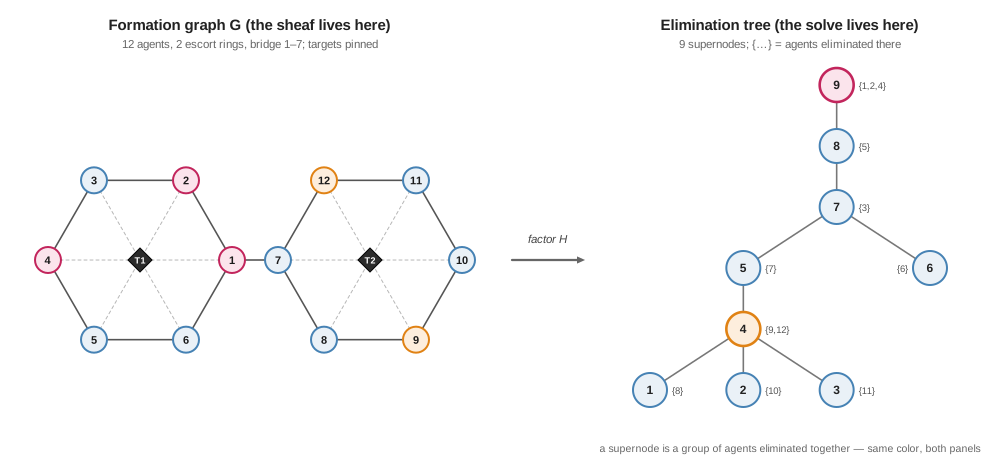
We use cellular sheaves to model multi-agent coordination. A cellular sheaf assigns data to the agents and communication links of a fleet, together with the maps that say when neighboring agents agree. The coordinated state is the harmonic extension of the sheaf Laplacian, which is the configuration on which every local agreement condition holds at once.
Posing coordination this way has two consequences. A moving target changes only the right-hand side of a linear system, so tracking, formation control, and consensus become the same computation under different data. And heterogeneous agents, which are difficult to handle with a hand-built controller, are different stalks over different vertices.
The project runs in two directions. The first is what can be posed this way: multi-target tracking, safety constraints expressed as control barrier functions, and coordination laws that tolerate agents updating at their own rates. The second is how to solve it. We factor the sheaf Laplacian once and cut it along its elimination tree, which turns each control step into a short exchange of messages, so that no machine holds the whole problem and the answer remains exact.
Project team
How the papers fit together
Tyler Hanks led this project through its first papers and has since graduated; it is now a broader group effort. James Fairbanks is an author on everything below, so each entry names the rest of the collaborators.
Distributed multi-agent coordination over cellular sheaves, led by Tyler Hanks with Hans Riess, Samuel Cohen, Trevor Gross and Matthew Hale, is the problem statement: nonlinear homological programs as a standard form for coordination, and a distributed solver derived by the alternating direction method of multipliers. Consensus, formation and flocking all come out of the same construction.
Heterogeneous multi-agent multi-target tracking using cellular sheaves, with Tyler Hanks, Cristian F. Nino, Joana Bou Barcelo, Austin Copeland and Warren Dixon of the Nonlinear Controls and Robotics group, moves the framework out of cooperative problems and into tracking targets that do not cooperate, with a Lyapunov proof to go with it.
Asynchronous nonlinear sheaf diffusion for multi-agent coordination, with Yichen Zhao, Tyler Hanks, Hans Riess, Samuel Cohen and Matthew Hale, drops the assumption that the agents update in lockstep and shows what still converges when they do not.
Whitney control barrier functions, with Keith Currier, Wilmer Leal, George Rauta, Austin Copeland and Warren Dixon, brings the discrete exterior calculus to safety constraints on a mesh, which is where this project and Decapodes meet.
Software
- CellularSheaves.jl – docs – coordination sheaves, harmonic extension, and the distributed solve.
- AlgebraicOptimization.jl – docs – the homological programs the coordination problems are posed as.
- CliqueTrees.jl – docs – the multifrontal factorization each control step runs on.
Written elsewhere
Tyler Hanks’s Multi-agent coordination with AlgebraicJulia using cellular sheaves walks through four coordination problems – consensus, stationary formation, flocking and moving formation – as one three-agent example with the edge potentials swapped out. It is the fastest way to see what the formalism buys.
Richard Samuelson’s Tree decompositions in Julia covers the factorization underneath the distributed solve.
Project articles
Where an entry carries a note, it says what the paper establishes and what to read it for.
- Hanks, T., Nino, C., Barcelo, J. B., Copeland, A., Dixon, W., & Fairbanks, J. P. (2026). Heterogeneous Multi-Agent Multi-Target Tracking using Cellular Sheaves. In European Control Conference. IEEE. (to appear). http://arxiv.org/abs/2512.24886
Target tracking, which is not a cooperative problem, is also a harmonic extension on a coordination sheaf. Because a sheaf can carry a different stalk over each agent, the formulation takes agents whose state spaces have different dimensions, and it survives nonlinear dynamics and disturbances. The controller built from the sheaf Laplacian is decentralized and comes with a Lyapunov proof that the tracking error converges. It is the paper that took the coordination sheaf out of consensus and formation problems, where every agent wants the same thing, and into a problem where the agents are chasing something that does not cooperate. It is also the lab’s closest joint work with the Nonlinear Controls and Robotics group.
Read it for The construction of the tracking sheaf, and the stability argument in section 4. The simulation study is a check, not the contribution.
Read first Distributed Multi-agent Coordination over Cellular Sheaves
- Zhao, Y., Hanks, T., Riess, H., Cohen, S., Hale, M., & Fairbanks, J. P. (2026). Asynchronous Nonlinear Sheaf Diffusion for Multi-Agent Coordination. In IEEE American Control Conference. IEEE. (accepted). https://doi.org/10.48550/arxiv.2510.00270
Sheaf diffusion still converges when the agents are not in step. Under bounded communication and computation delays, nonlinear sheaf diffusion reaches a minimizer of the coordination sheaf’s Dirichlet energy at a linear rate set by the delay bound, from any starting configuration. Every earlier result in this line assumes agents update synchronously, which a real fleet does not. This is the paper that says what the framework still guarantees once that assumption is dropped.
Read it for The delay model and the convergence rate. If you only need the result, the statement of the main theorem is enough.
Read first Distributed Multi-agent Coordination over Cellular Sheaves
- Currier, K., Leal, W., Rauta, G., Copeland, A., Dixon, W., & Fairbanks, J. P. (2026). Whitney Control Barrier Functions: A Mesh-based Geometric approach via Discrete Exterior Calculus. In IFAC. (in press).
Control barrier functions built from Whitney forms, so that a safety constraint is a discrete differential form living on a mesh rather than a smooth function on the state space, with the discrete exterior calculus supplying the operators that enforce it. It is where the coordination project and Decapodes meet: the safety machinery of control theory posed in the same discrete exterior calculus the simulation work is built on, so a constraint and the physics it constrains are written over one mesh.
Read it for The construction of the barrier function from Whitney forms.
- Hanks, T., Riess, H., Cohen, S., Gross, T., Hale, M., & Fairbanks, J. P. (2025). Distributed Multi-agent Coordination over Cellular Sheaves. In IEEE Conference on Decision and Control. IEEE. https://doi.org/10.48550/arXiv.2504.02049
Coordination of a multi-agent system can be posed as a cellular sheaf over the communication graph, making the coordinated state the harmonic extension of the sheaf Laplacian rather than the output of a purpose-built controller: the coordinated state solves $H q^\star = -B p$, where $H$ is the agent block of the Laplacian and $p$ the current targets. It is the problem statement the rest of our coordination work refines: every later paper either solves that linear system faster or relaxes an assumption it makes.
Read it for The sheaf construction and the Laplacian. The experiments can wait.